I guess if you tell white people or men to please not be an asshole and make it all about them it's the same thing as censorship. Good to know. Also, another thing I've learned is that if you post something on the internet, people think they can say whatever they want and do whatever they want. Does anybody else see a problem with that?
You know, the most disturbing thing about these comments is that reading them is just like reading the gate crashers who invade topics about rape or DV and try and change the subject from what women experience in a sexist society and power structure to what a tiny minority of men experience that might be like what women do.
In this case, what so many people are doing here is ignoring the context in which it occurs. Black peoples' image has been controlled and outright erased by white people for centuries. These dolls are a tiny step toward rectifying that. Black women have been utterly dehumanized by the way they've been portrayed by white culture, and their voices have been silenced.
I saw one comment that talked about how the commenter worked at a doll store or some such shit. Yeah....on a post about racism. And of course there's trolls yapping about censorship.
@Ginmar Rienne: So everyone who disagrees with you or Latoya is a "troll" huh? Or, for that matter, anyone who "yaps about censorship?" Well I'm sorry, but Latoya and Dodai made censorship part of the debate, not the other way around. What I got from Dodai's post, chastising people for "bringing their personal experiences" into the comments, was that everyone should shut up unless they agree with her. And I'm sorry, but that reeks of intellectual fascism.
Notice, by the way, that if you're a Black woman relating a Black experience, you aren't off-topic, at least according to Jezebel. It's only insensitive white people that want to talk about freckles on a barbie doll that receive the brunt of their wrath. Why? Discussions on race should not be limited to one ethnic group's personal experience. That's why a dialogue, and not a monologue, is so important in furthering everyone's understanding of race relations. It's important for each side to know where the other is coming from. If any comment is dismissive, or misses the point, you can reply to it and insert your point of view. That's what I used to like about Jezebel - that there was a healthy discussion between people of all walks of life. If the editors choose to limit that, then I will no longer visit this site.
P.S. Don't reply with the equally dismissive line, "You obviously didn't understand where Dodai and Latoya were coming from." Trust me, I did, and that's why I'm so pissed off.
I don't comment much on the race posts. This is because, as I posted in the Comments of the Day thread, that often time the only comment I can think to post compares the problems in the post it to my own experience. I'm a not particularly thin, nearsighted white woman with curly hair. I have my own issues with the patriarchy and the expectations of modern society. They are not the same as the experiences of black women, and to compare them can come off as belittling those problems.
So I don't comment. I read instead, I save my empathy for posts where my experience is directly relevant. Having commenting privileges does not mean that I have to comment on everything. Days may go by before I leave another comment on Jez. I read the articles, I consider my response, and then I decide whether I really have something to say.
@Ginmar Rienne: Distinguishing between trolls and regular commenters is accomplished by you (personally) based on whether or not you like what they have to say.
I was a troll to you some time past because, as I am a military wife, you felt I had no business commenting on a post about the military. Never mind that, as someone also employed in law enforcement, I end up knowing a lot about background checks for members of the military. According to you, I had no business on that thread. You are someone who automatically discounts people's experiences based on your personal opinions and whether or not they are saying what you want to hear.
Now, I normally avoid you by not posting on the threads you're involved in, but you have a nasty history of calling out other posters as trolls because you want to police what they say. I don't make thinly-veiled references to your posts and I think it would be a less-hostile environment here if you showed me the same respect. Pompously demeaning someone for "yapping" when you don't like them is starting down the same road as white people trying to silence blacks.
@smizmar: Sorry, I don't know you and now I have even less desire to do so. You refer to some grudge you've got against me, complete with some offense you still resent, and think that I'm going to take you seriously? And top it off with personal attacks?
Wow, why on earth could anybody have a problem with that?
@Ginmar Rienne: I like how you get offended by other commenters and then discount their commentary.
Nobody is changing the subject.
As stated before, I read this article, noted it, and moved on.
I only came back to it after reading a pedantic post the following day about how other people's comments weren't welcome.
More importantly, the only reason I left a comment here was because Dodai didn't allow for commentary on her post where it belonged.
I've been posting on this site for over 3 years. I've read enough comments to know when someone is trolling and when someone is trying to relate an opinion and having trouble.
You might try honing your skills before you paint every comment you don't agree with with a broad brush.
@NerD: Blattella: Well, gee, Mr. Patronization, I can't imagine why your arrogance and disimssiveness isn't winning the day with me! Did your widdle feefee get hurt?
God, stop waving your dick around.
I read this article, and was interested in it primarily because it shows what is RIGHT about America.
Mattel can't make a product line that accurately represents all of America's ethnic breakdowns so it makes a series of dolls it can mass produce. This enrages individualists, and spurs on a side industry of aftermarket dolls
Great! It's a textbook example of the free market at work. It's an example of what this country does well. It also shows that debate about race is healthy for this country.
I check today and there is a post directed at this one, which essentially tells everyone that their comments are embarrassing, and they shouldn't bother to relate personal experiences when talking about race.
Having a conversation about race is nothing without the personal experience. You cannot understand the pain another person goes through in the abstract.
If you don't agree with what someone is saying, you are more than free to do so. In fact that should be encouraged.
Telling them in a post with no option for rebuttal telling them their opinion isn't welcome?
I'm a guy, as such my experience with Barbie is limited. All of my dolls were green, or robots.
I do however have this PERSONAL experience with them.
I worked through my late teens at a Toys R US in Arizona. If you know anything about Arizona, you know the racial makup of the town has a proportionally lower number of Blacks than Hispanics. During the Christmas holidays, we would get several boxes of Barbies, and it was my job for one month to do the "pink aisle."
Each crate of barbies dolls would come with the following ratio: 25 white Barbie dolls, 5 black Barbie Dolls.
Nobody bought the black Barbie dolls.
Towards the end of the holiday season, we would get a rush of panicked grandmothers who would come in and ask, very apologetically, if we had any white Barbies.
I would give a stock answer that "what you see on the floor is what we have", and I would mock them to other employees who hated that question as well.
You see, we were looking at it from the wrong end of the spectrum: We were thinking that Grandma was a racist for not wanting to give her granddaughter a doll that didn't "represent" them.
If I met that kid today, I would have a long hard talk with him about that.
I instead see the post about this as a warning that maybe not everyone should post on every articled just because they can. Read the article, see if you have something to say that furthers the conversation of the article, and if you don't, wait for the next one. But that's just how I read it.
@NerD: Blattella: @dangerslut: I thought the recent post about this subject was agressive. All comments were respectful and had reasonable arguments. It is the moderators' task to ensure that, as such, they are respected. I understand it if they don't agree, but that could have been resolved by simply replying to them. I come to this site to exchange opinions, not to be lectured on a post that can't be commented on.
@Marla Singer: Personally, I felt that some of the comments on this post were dismissive and thus disrespectful. I encounter comments like that on many race-related posts on Jezebel. I appreciated Dodai's post.
@NerD: Blattella: Do you have anything to share about the experience of being a black woman in 2009? I'm having trouble understanding how your story about your job at the toy store is really on topic.
Barbie is a toy. And you work at a store that sold toys. And some of the toys had black skin. And some people reacted to the different skin colors of the Barbies. Some showed preferences.
Again, not seeing it. Agree with Latoya and Dodai on this one.
@thesciencegirl: It could be the case. I didn't read all comments. I still think this was aggressive and that the whole thing originated in the main idea of the article: that all girls need to be represented by their dolls. I don't agree with this idea, and still agree completely with the fact that Mattel is making Black dolls, for different reasons. I mean, I think this issue could have been treated with a wider focus (i.e. the place for Black people in pop culture, etc.) but ended up in a discussion that necessarily implied the input of personal experience.
@Marla Singer: "It could be the case." I'm telling you that it is the case. Maybe you don't see it because you don't experience it, but it is really, really frustrating that just about every Jezebel post on black women, whether about dolls or hair or any other topic, is derailed by comments from white women who want to make the conversation about them. And who basically respond to the black women commenting, "Your experience is false," or "I understand your experience better than you do," or "Your experience is not unique because I have lived through "A" and you have lived through "B" and they are totally the same." It's demeaning. It's silencing. It's alienating. It lessens my experience at Jezebel. And it needed to be addressed.
@thesciencegirl: There are offensive comments, and those are out of the question. As for the rest: Maybe they intended to aim for the issue of discrimination in general, which most of us are victims to. Maybe they didn't mean to colonize other's people experiences with suffering by adding their own. I know I didn't. I apologize if any of my comments on these posts were interpreted in an offensive manner, because I didn't mean to step on anyone's ideas or opinions. I could be Asian, Black, Jewish, Latina or anything else, but discrimination of any group hurts and feels relevant to me, that's why I comment.
@Marla Singer: Latoya wrote a brilliant comment just now downthread, in which she said this:
"You are correct in that we cannot judge the intent of others - this is why we say that the *effect* also needs to come under consideration. If you don't intend to kill someone but do it anyway, the end result is a person is still dead. If you perpetuate racism unintentionally, the end result is still upholding a racist system."
I think a lot of people would do good to listen and absorb what Latoya and Dodai and others are saying here, instead of rushing to speak in their own defense. Regardless of what the intent is, I leave many, if not most, Jezebel posts about black women feeling upset, silenced, and annoyed. These feelings are not mine alone and they are real effects of the comments of others. Whatever their intent, the damage they do is real.
You don't owe me an apology, and FWIW, I wasn't talking about your comments from yesterday. I just get the feeling from the general response here that people don't understand where Dodai was coming from.
@ChicagoSaphique:
I'm not here to give an opinion on what it is like to be a black woman in 2009 based on a doll post. Are we going to have a litmus test on who can and cannot comment on a post?
I'd like to know how that is going to work.
For instance, my post shows how you can have something useful to say about the dolls, and how people relate to them without fitting a racial or cultural box.
@thesciencegirl: Well fuck me, why not just ban all white people from commenting on posts relating to black issues? I mean, obviously, whites are completely ignorant on all issues of diverse culture!
I didn't even comment on the original post but, even so, it was irritating to log in today and see what was basically a finger-shaking lecture on censoring our own conversations, without the opportunity for a rebuttal by the original commenters who were being criticized. I'd think that if you posted something on the Internet for the whole world to see, you might have a slight expectation that people will comment on it, and comments have a sneaky way of leading to other related topics.
The real problem here is that, in spite of obstensibly standing against censorship, this site censors more than any other I read. I mean, what is the point of writing posts that you want people to read and comment on, only to tell your readers what they should write in response?
@NerD: Blattella: Yeah, but you're doign exactly what is the problem: we're talking about racism and black women and girls and representation: you.....talked about selling dolls. Yeah, not a tangent at all.
@NerD: Blattella: The issue with that was the source article dealt with the *heavy levels of criticism* Mattel and Irby-McBride are falling under from the black community - not whether or not the line was successful in various areas of the country. If the topic was about, say, flagging sales then your comment would have made a lot of sense.
But since the article was about reasons why Irby-McBride is facing criticism from the black community, and since the Wall Street Journal extensively covered the issues about race and representation, this was not an article about doll sales - it was an article about perceptions of race and how that impacts the doll. (They did not even touch the sales in the source article.) This is part of the major disagreement - if you don't want to talk about race and culture, fine. But to add comments like that on a post specifically about race and culture is derailing. Saying "this isn't about race, we want to talk about the dolls" when the whole article is about race doesn't really make sense.
@thesciencegirl: You know what I just realized? Pretty much all of the white women I know love playing the one up game, and you nailed it. I've heard them downgrade each others experience, they always have it worse than the woman wanting to confide in them and seeking support, just to be told "Well at least you didn't/aren't/weren't (insert experience here) like me."
Just thinking about that reaction makes me livid because I've had it said to me when I was in a very bad place in my life, and the only message it sends is "You don't matter and I don't care what happened to you. I've had it so much worse." Certain people just have no empathy, and it is tragic.
@LatoyaPeterson: The idea of using an article from Wall Street Journal and then claiming your article doesn't have a business bent is like using the Bible as a source and then discounting religious commentary.
These dolls weren't made out of some misguided sense of equality, they were made to make money. The criticism, and the aftermarket sales mentioned in your article are direct correlations to business decisions made by this company.
Everything you noted and wrote about could be outlined and used in an Econ 101 class to explain how the free market system works.
Your article might have been only about race for you when you wrote it. The problem is you don't just write for yourself.
If you wanted to write this for a personal blog where you can use your editorial discretion to remove commentary that wasn't specific to your agenda, then you would be perfectly entitled removing or discounting any commentary that didn't follow your narrow definitions.
You didn't. You wrote this, for pay, on a public blog. A public blog with a diverse group of readers. That opens your article up for analysis and commentary.
As I stated before. Race is a personal subject. Everybody has one.
I would not expect you to understand what it is like to be a mixed race Latino male who looks Irish, and wasn't taught Spanish. I could explain to you how the strange hobgoblin of racism rears it's head in different situations when I travel in this country. I would expect you would have commentary about that, and I would expect you would want to relate it to your personal experience.
I wouldn't, however, belittle that commentary or experience by stating that it wasn't good enough, or that it was not on topic. Mostly because that commentary lets me know more about you, and how you relate to the stories I tell.
Hopefully, at some point later on, you will see this as a positive learning experience.
@smizmar: "Well fuck me, why not just ban all white people from commenting on posts relating to black issues? I mean, obviously, whites are completely ignorant on all issues of diverse culture!"
You really need to not unload your irritation at this topic on me, when I've clearly said none of the things you refer to above. If you're interested in engaging with what I've actually said, I'm listening.
I don't really want to touch the racial stuff, mostly because every point I could try to make has already been made far more eloquently than I could've, but I just had to ask: am I the only one who, before clicking to enlarge, thought the one in the foreground was wearing an AKA sweatshirt?
I am really starting to hate writing about racial issues for Jezebel.
To all the folks who point out that the white barbies don't look like you either - we know. We know that Barbie's measurements are ridiculous, that she puts forth a beauty standard toward white woman that is almost as unattainable as it is for black women and other women of color, we know that molds lend to standardization, we KNOW.
Feminism is full of scholarship about Barbie's impact on white women. It's no fucking picnic for you guys either - we get it.
But it's frustrating to have people keep deliberately inserting their experiences into a narrative that does not fit. It's not the same experience. I can read about what it's like to grow up as a middle class white girl, but I don't live it, so I don't know.
I do know what it's like to grow up as a lower-class black girl whose parents gave her science toys and books to read, and I can only think of owning two Barbie dolls (one black, one Hawaiian) my whole life.
Did Barbie impact me personally? Not really - I wasn't inclined to play with dolls, and I was conditioned to recognize when I was being sold something. I learned from a very early age that white beauty isn't the only beauty and there was no reason to feel bad about some white doll thing when there were so many other cool things in the world.
But that was *my* experience.
My cousin, who had dozens of Barbies and their cars and their dreamhouses thinks Barbies are wonderful toys for her four year old daughter. My cousin jokingly describes herself as looking for a Ken (we are both moving into our late 20s) and keeps her hair long and relaxed.
Unlike my cousin, I never hid under a towel at the pool to keep my skin from turning darker.
And unlike some of my friends, I never felt that sting of being passed over to play with Barbies because there weren't enough black one's to go around. I didn't walk around with a towel on my head swinging it around as if it was long flowing hair, and I didn't (as described in a seventeen magazine article that was published when I was still in the age range to read it) pump out lotion and leave it on my skin pretending I looked white.
I never felt that pain that one of my friends felt when her classmates teased her about having dark skin and short hair, even though it was relaxed and she used a variety of products to try to make it grow.
And I never felt the kind of pain one of my other friends felt when she went up to her white crush and confessed her feelings, only to have him reply "But...you're black." All the parental affirmation in the world was not helping then.
When you have children, you are their primary example. For a while. And then they go to school, they socialize with others, they pick up words, ideas, actions that you never would have dreamed they would. Some of my friends had color struck parents. And some of my friends just got caught up in a glossy, aspirational, media saturated world that paints a very clear picture of who in our society is beautiful and wanted and who is not. Barbie is a part of that. Hollywood is a part of that. TV is a part of that. Advertising is a part of that. And it is relentless and endless.
It might not make sense to some of you who have not felt the sting of feeling entire pieces of your identity excluded from view and representation. Who take for granted that while you may not relate to Blake Lively or Lauren Conrad that you can always turn on the television and see someone of your race and your gender doing all kinds of activities and seen in all sorts of contexts.
If you've never had to hunt for "the one" in media, you are not going to be able to get why Barbie representation is so important to people.
If you felt like you could relate heavily to Daria and Jane but you were still thankful for the one time Jodie made a speech about being the only black kid at Lawndale, if you watched The Craft because it was awesome, but you always remember that it was Rochelle who got told that her "little nappy hairs" looked like "pubic hairs" or you just realized that the only "role"for black girls in society was as the silent/funny/pathetic side kick in a white girl's story then you understand.
This isn't a narrative unique to black women - many, many of us are erased. But the black woman's story is the one I know best because I live it.
If you don't give two fucks about Barbie, great. Bully for you. Dolls don't really move me to action either. But in the context of our society, and how pop culture shapes not only the fantasies that people have but also limits the spaces where they can visualize being, where women grow up to have Disney themed weddings, where Barbie is a global icon, you cannot tell me that a little spit shine and whimsy is all kids need to get over years of conditioning on various fronts that something about them is inferior.
@LatoyaPeterson: I know you're venting, but I wanted to say that I'm glad that you write about race for Jezebel.
'If you felt like you could relate heavily to Daria and Jane but you were still thankful for the one time Jodie made a speech about being the only black kid at Lawndale, if you watched The Craft because it was awesome, but you always remember that it was Rochelle who got told that her "little nappy hairs" looked like "pubic hairs" or you just realized that the only "role"for black girls in society was as the silent/funny/pathetic side kick in a white girl's story then you understand.'
That's why. That's me (as a youngun' anyway). You write insightfully and humorously about all sorts of things, race included, and you create opportunities for discussion about perspective, compliance, and personhood, and a whole host of other topics that wouldn't get talked about. I appreciate that, especially from someone who has shared experiences that are similar to mine.
@LatoyaPeterson: You're awesome. I think you scare people. And that's good. And I'm glad you write about race for Jezebel, it's confronting and a lot of people need to be confronted.
@LatoyaPeterson: Thank you! That was incredibly well-put. I also dread reading the race/ethnicity-related posts on Jezebel (though I can't help myself and read 'em anyway) because of this phenomenon.
One thing some white feminists have to learn is to just LISTEN sometimes and not try to colonize someone else's narrative or experiences.
"Kids used to make chinky eyes at me and my brother. They'd make ching-chong noises at us sometimes."
"Kids used to make fun of my freckles and red hair. They used to make fun of me with fake Irish accents."
These seem like similar experiences but they're not the same. The former is imbued with histories and meanings that the latter isn't (at least, not nowadays). Treating them with equal weight conceals those histories and meanings.
That's not at all to say that white women are a monolith, either. Or that that obviates the ability for sisterhood and coalitions and all that good communal stuff. But the taking over of conversations started by women in disadvantaged positions within the feminist movement by those who are more advantaged is a trend I've definitely noticed in the comments.
Listening (or reading, I guess) can be just as or more supportive than chiming in all the time.
@LatoyaPeterson: In the process of demanding validation of little Black girls who do NOT look like these dolls, do we invalidate the little Black girls that DO.
I agree, the dolls need more variation on skin color, hair texture/length, and eye color. However, there are PLENTY of Black girls who look just like these these dolls. Their hair is naturally curly, wavy or straight, skin naturally light or caramel or sepia toned, eyes naturally lighter brown to green to blue. Are we really saying that since these dolls aren't "Black enough", then neither are those Black girls who look that way either?
Trust, I hear you on this issue. What concerns me is that in a effort to include everyone, we tend to exclude some.
@LatoyaPeterson: I don't know if you care about my opinion, but here goes:
I am sorry that you felt that way growing up. I have no idea what it was like to feel so excluded or different because of your skin. I am a white woman from Georgia. I grew up in a trailer park, and most trailer parks, let's face it, are full of poor white people.
I was even a little blonde girl. When I was little, I preferred the dolls that DIDN'T look like me. I didn't like Barbie. I liked the red head, the "hawaiian" doll, and the black doll the best. I didn't like my dolls looking all the same. Not that then it was a political statement.
I think it's pretty shitty to be a child and not see representation of people like you in the media, or around you. I have no idea how alienating that is.
I was ashamed of my poverty, of the popular pretty girls shrieking "YOU LIVE IN A TRAILER PARK?!?!" in the lunch room, and laughing at my free lunch card, my clothes, my hair. Black, white, all the popular kids picked on me off and on throughout my early childhood.
And I know I felt like shit. So I'm pretty sure what you went through was heartbreakingly awful.
I'm sorry for it. I wish that things were different. I wish that people didn't think someone with darker skin was automatically not pretty. It's ridiculous, and a child shouldn't be shamed for their body.
...this is really long and crappy, but hey.
Great post. I appreciated being able to read it, and I hope I got my meaning across.
@LatoyaPeterson: Everyone inserts their personal narratives into everything they talk about, especially on the internet. "Don't accuse all men of being the lax parent in the marriage! MY dad was a great parent!" Everyone who's been through EN-101 knows that generalizations have basic value and that you can't undo them just because your story is a little different. And of course, you vented your anger at white people doing this here and then proceeded to lay out your unique tale as evidence for why you're more qualified to comment on this story than a lot of us seemingly are.
@ceejeemcbeegee is not here: But there's an overrepresenation of light-skinned/mixed looking black girls in popular culture--from hip-hop video vixens to entertainers such as Halle Berry, Beyonce and Rihanna, to the wives of black athletes/preachers/politicians. It's not that these girls aren't black enough, it's that all too often they are chosen as the representation of blackness in popular culture. When we do see darker-skinned black girls/women it's usually in a film like "Precious," and, in that case, no one's angling to be them.
@voteforme: Actually, no. Re-read the comment, which was addressed to those who point out that white barbies don't represent them them either. Not white people, in general. Generalizations can have some value, but they also can become a burden to historically marginalized groups - particularly if a person not from that group uses or co-opts another's experience to invalidate a lived experience. And while I shared elements of my life story, you'll notice that many of the stories were things that I witnessed - they did not happen to me.
You mentioned generalizations - one of the things that some of us in various groups use to connect and discuss is a commonality of experience. Racism has an uncanny way of acting out the same behaviors over and over again - therefore, there is a higher probability that many of us have experienced racist dynamics at play. There's a big difference between that and flattening an experience by denying that there are systemic issues of racism that may influence why people feel so strongly about accurate representation - or, overwriting the shared commonality of these experiences since they don't directly match up to your own.
@ceejeemcbeegee is not here: We discussed that on Racialicious, a few weeks back. My commentary here was specifically in response to the "Are These Dolls Black Enough?" question posed by the WSJ and the comments therein.
In a few words, no, we do not want to exclude anyone. Our groups are not monoliths, and the discussion threads over there a lot of people identified as looking like some of the dolls even though they do not identify as multiracial.
However, the issue of representation is a difficult one, which is why I directed readers to the Mattel site. Irby-McBride makes a point of discussing why she was motivated to make these dolls - representation. She specifically discussed having broader features on the dolls, which she felt represented a look that more black girls can relate to. However, she then launched into an explanation of why "it's more fun" to play with a doll with long, straight hair - and market reasons aside, that could be problematic for many parents. That's why those things were pointed out.
I was also interested to see that the other doll modifier set upon the dolls and immediately changed eye color and hair texture, because she thought those changes would be more representative. As I wrote, neither of them were happy with current representation, so they both, in their own ways, set about changing it.
I think the danger of de-valuing another person's parallel that would otherwise allow him or her to empathize with how you feel (i.e. "I know how it feels to be picked on and judged for your looks, I was the heaviest kid in the third grade.") is that you put your experience into some compartment where it's untouchable and unrelatable. And you prevent other people from learning how to better bond with you and how to manage their behavior to offend you less, because you deny them the opportunity to relate.
@LatoyaPeterson: I can understand your frustration, but isn't this what modern feminism is all about?
The early feminist movement was pretty upper class and white, and it's only in recent years, among this 'Jezebel generation', that feminists have consciously tried to include other voices besides those of relative privilege. It sucks that everyone seems to have that overwhelming human urge to empathize to any post by relating to their own experiences, but it's part of the larger discussion, and it's in that back and forth people can come to understand that such interaction can sometimes serve to diminish and patronize the person telling the story.
But it's important that these stories, and the subsequent discussions, continue, because it can't be feminism without hearing, respecting and being fundamentally shaped by the voices of black women. (And Asian. And Hispanic. And gay. And white.)
@LatoyaPeterson: That was beautiful. Thank you. I often don't comment on posts that don't reflect my personal reality, race based or not. I feel that its a time to read the POV of others and maybe learn something. I don't think everyone has to add their tangential two-cents to everything posted on Jezebel.
This kind of dynamic happens often on my blog. A person who is may not be of a the race/ethnicity being discussed shares a story about their experience. It is not the same. However, there are two very different ways people go about it.
One is when someone is trying to *affirm* an experience by relating it to their own lives. They talk about marginalization based on their sexuality, or based on their race gender combination (for example, many Asian American males and African American females find common ground in being portrayed as undesirable partners in the media). The experiences of an Asian American male and an African American female are not the same - however, there are enough notes of similarity where when we write a post, someone wants to reach out and say, "hey, I feel you on this - you are not alone."
The second is when someone is trying to *deny* your experience based on their limited reality. This is what I object to, because they are building what is a false parallel. So, comments like "As a white woman with kinky hair, I think it's ridiculous that black women wouldn't want to straighten their hair! I straighten my hair to look presentable and so should you!" (We actually received that comment on Racialicious, but it went on for paragraphs). It is frustrating when you are talking about a large, systemic issue and people try to make it about the individual. Saying "well, my barbie didn't look like me either" or "women in ads don't look like me" as a way of dismissing the systemic in favor of the personal actually stalls conversation.
And to be frank, its one of the reasons that Racialicious focuses our comment mod policy the way we do - our readers hear that shit all day long. They want a space in which the participants are already aware of the differences between systemic and individual acts of racism and can discuss them intelligently. (And, for some reason, our white readership on the site manages to participate in these convos just fine.)
Is this a large issue in feminism? Oh yes. But the frustration comes not because people just *aren't aware* of these differences - it is because when you present the facts, that are too busy navel gazing to listen.
@LatoyaPeterson: Thank you for this. I'm a little astonished that people still continued to make those ridiculous comments even after you wrote this.
I just wanted to say that I hope you do continue to write about race for Jezebel. You're an excellent writer you contribute greatly to this site. I grew up outside of DC, raised by two extremely liberal parents who believed that the greatest lesson I could learn was that everyone was equal. I played with both black and white dolls as a child at my mother's insistence. I was an African Studies major in college, I've lived in South Africa. But you know what? I still know nothing about the African-American experience. Reading Jezebel has opened my eyes to everything I still have to learn, much of which I'll never understand because it's not my experience. But that's the beauty of this site, and of your contributions to it, I get to sit back, listen, and learn. I've been confronted constantly with my understanding of race and ethnicity in ways I could never have imagined. So please stick around, I appreciated being confronted. It's the only way to move forward.
@LatoyaPeterson: When someone responds "I'm white and I have frizzy hair and I think it's no big deal," yes, that could be a statement used to rationalize white hegemony. But it could also be a (perhaps failed) attempt to understand what makes the issue so important to someone. (An outsider can't judge the commenter's intent).
If the attempt ends in failure, does it mean that the writer's effort to understand wasn't worth it? Maybe it does. But shutting people down--censuring them for "not getting it"--discourages people from trying again.
I get it, I've been there: it's tough to watch someone treat lightly an issue that you consider very serious and personal. But people are self-absorbed by nature and by necessity: I'm not going to be passionately concerned with factory conditions in Cambodia if my own life is falling apart. I just don't have the mental energy for it. It's one thing to ask people to be respectful of different ways of life; it's another thing to ask them to put their own thoughts and experiences aside while doing it. I'm not saying that people aren't morally obligated to try--but I am saying that they're not morally obligated to succeed.
Latoya writes: But the frustration comes not because people just *aren't aware* of these differences - it is because when you present the facts, that are too busy navel gazing to listen.
To which I say, true: but can you ever understand another's experience outside the context of your own? That's what empathy IS: we can only be empathetic to others to the extent that we can see their experiences as contiguous with our own.
This discussion has made me reconsider remaining on Jezebel. Not Latoya's post itself, but Dodai's response (which I can't respond to, so I'm addressing it here). It's one thing to say that "you're not understanding an issue." It's another thing to say "Your experience as an [Asian, European, Hispanic, immigrant, etc] isn't relevant to this discussion, so it isn't welcome"… especially since Jezebel doesn't provide equal opportunities for these other groups to talk about their experiences. And what if they did? Would we just segregate people, so that all the white people read certain threads, and all the blacks read others, etc, etc?
According to my secular humanist values, it's important to acknowledge differences among people, but it's more important to nurture similarities. Real understanding between people is incredibly difficult, and for that reason, it's important to accept partial success, meet failure with patience, and, most importantly, to NOT SHUT DOWN other's thoughts and opinions. So, I think I'm done here.
@LittleDogLaughed: Real understanding can only happen if people empathize, not overwrite their experiences. Those of us who are privileged (and we all are, in various ways, just as we all have our own battles to fight) have the ability to make light of someone else's pain.
On an individual to individual level, this is painful. On a societal level, it is catastrophic.
Some people have endless fountains of patience to continue to challenge the same prejudiced ideas over and over again. But many of us do not. This is not the first time I've encountered any of the lines of argument above. And while, on an individual level, it seems fine to try to engage someone with conversation, over time, those of us who are in a historically marginalized group find ourselves arguing the same points over and over again in an endless loop. Sure, it's cool the first three times you explain something like this. But the 300th? 3000th? There is a reason why many people blogging about issues of social justice maintain that members of marginalized groups have no obligation to teach anyone. Why? There are millions of blog posts, thousands of books, discussion notes, podcasts etc, dedicated to explaining any thing you want to know. Asking people to continually perform on demand is demoralizing.
in my experience, folks can learn all the theory, all the right words, all of it and yet act fundamentally the same, live out the same patterns of thoughts, still hold the same fucked-up priorities. and yet spout all of the anti-racist rhetoric.
because that is all it is to them. rhetoric.
people only learn as much as they are willing to learn.
and anti-oppression is not complicated. you dont need to read a book or a take a training or read a blog to learn humility, respect, and love. [...]
i guess what i am saying is that in my experience if white folks want to be respectful of poc or understand where they are coming from–they dont need a workshop. there are centuries of writing from poc that they can dive into. there are plenty of poc in their neighborhoods and community organizations. when white folks are ready to be anti-racist, when they are ready to turn from facing the center, to facing the margins, and stand with us. we will be here
Sharing of ideas, conversation, open-discourse do not work if people reject the reality of others in favor of maintaining their ideas about the world. No one is saying that this isn't difficult or complicated. We all have moments when we fail. We all have moments when we stubbornly refuse others the empathy we crave for ourselves.
However, we are also operating within a system that rewards this micro acts of prejudice. And I don't see the point of engaging, endlessly, particularly if people don't really have any need to change. I can call myself a gay ally until I am blue in the face, point to all the posts I've written or deeds I've done, but it would not change the fact that I, as a heterosexual, will never be the target of that specific brand of prejudice. And as such, maybe I should be careful of trying to insert my hetero-narrative into a context where it doesn't fit.
At the end of the day, I can walk away from the conversation and go about my life. Others live it. So, in general, it is a good rule of thumb to tread lightly. For some people it is a thought exercise, for others, this is their lives. And while I value my opinions and perspective, it is important to remember that everything is not necessarily about how I see things.
Jezebel has very different norms from Racialicious, and I voiced my anger precisely because that is the way you all do things here. Over on Racialicious, we do it very differently. There aren't really conclusions to be drawn from that, but I do find it interesting that on black barbie posts or black hair posts or various other posts, the same arguments manifest time and time again.
Some people have mentioned this exchange has been helpful to them, and I am glad for it - however, I should clarify, so people do not continue to worry.
I do not wish to write about race for Jezebel. Where I am, and where I focus my activism, I prefer to work with other people who recognize the issues with systemic vs. individual racism, and are interested and willing to compare the ways in which oppression impacts us in order to raise a stronger fight against it. I've written about race daily for a solid three years now - I know what I want to accomplish. I just spent three or four hours I could have been doing other things responding to people's concerns, and while that is fine sometimes, it isn't a sustainable practice.
Since I, like everyone else, do not have the luxury of single issue. I will still write here for the other things I am passionate about. But I don't feel the need to engage all the time. My writing, the writing and speeches and talks of others, all of that are around if people want it. But I firmly believe that you will not change anyone's mind about anything unless they are willing to hear it.
You are correct in that we cannot judge the intent of others - this is why we say that the *effect* also needs to come under consideration. If you don't intend to kill someone but do it anyway, the end result is a person is still dead. If you perpetuate racism unintentionally, the end result is still upholding a racist system.
But I am not overly concerned about this. I am one person, working at something that millions of others did before me and millions of others will do after I am gone. I do what I can.
And if people find my ideas intriguing and want to subscribe to my newsletter, they know how to find me.
@LatoyaPeterson: I totally get it. The navel gazing does stall the conversation, and I think that this comment thread has turned into a very nuanced conversation on the identity and commentary that I think we should all read.
The hair issue is a beast, though. There is a cacophony of opinions from within the black community on 'good' hair and 'natural' hair that white and asian (and most Latina) women just do not understand. A non-black woman with curly hair does not face the same potential statement of politics and culture with her hair style as a black woman does (if anything can be seen as a near parallel, the choice of covering ones hair in Judaism and Islam comes close as a visual signifier on such things). And it gets old, both the insistence on intimately understanding and the idea of straightened hair being more 'presentable' somehow.
But, if anything, the constant debate might allow some reasonable people to learn how to listen, and not always thinking the commenting equivalent of what they are going say while someone else is talking. (Hope that metaphor holds as well in print as it did in my head.)
And, my larger point, which I'm not sure if I made as clearly as I could, is that the constant need to relate, while humane and admirable, gets in the way a lot, and especially within the history of feminism, tends to subsume minority voices. And I think that by doing what you do, while it may seem like rolling a rock up a hill sometimes, will eventually wake some people up, and make for a greater diversity in this loose federation of women, and hopefully, get us somewhere better than where we are now.
@miss.terious: There's a BIG difference between empathy and derailing, and most of the comments people are complaining about have been derailing. It's not an issue of people saying "I know how it feels because I had a similar experience over a similar period of time," but rather "I know how you feel because someone did something kinda like that to me one time. Of course, because of my privilege and position in society, it was only that one time and I had other venues of expression so I could avoid the situation, but man that one time sucked!"
Or worse, "Well I didn't experience life that way, so your opinions on your own lived experiences and the lived experiences of people in the group you occupy are invalid."
If that's all people have to say? Then they can kindly keep quiet.
@FrankiTheB: Look, clearly there are always boundaries and common sense. For me to say, "I can feel your pain at having your family massacred by a rebel army because I lost my cat to a coyote attack last week," is clearly absurd and self-centered. Obviously part of relating is knowing where to stop. Nobody wants to be *that* TV character who makes everything about her.
But I honestly believe that in a forum where the goal is thoughtful communication and understanding, part of what is happening, and what is making some commenters so angry, is the devaluing of personal experiences that they offered up in a spirit of honesty in what they thought was a trusting and loving environment. And, by the way, when that personal experience is something that still evokes pain and sensitivity, and something that has become a part of you, rejecting that experience as a valid contribution is kind of like rejecting you.
Let's all cut each other some slack. Let's assume that when we share personal experiences, we're trying to be relevant and we're trying to further the conversation, not derail it. I haven't read 100% of this thread, given how much it's grown, so I'm sure there are comments here that I would think don't belong. But most of the ones I skimmed seem genuine, and I would much rather have them all come out, and have us discuss and correct people's perceptions where need be, rather than shut them up, make them feel angry and irrelevant, and have them internalize that anger and continue to relate poorly.
@miss.terious: I understand your point, but when people make the issue about them all the damn time, I'm unwilling to cut anyone slack. This happens in every non-Racialicious discussion of race I've been involved in, and it sucks. I'm tired of being asked to trust that someone has good intentions as they repeatedly slap me in the face. If you're not trying to derail the conversation, but make a derailing comment anyway? That's still derailing! And no one should be expected to bend over backwards trying to educate people who express an unwillingness to get it (for examples of those people, see all the comments going "So you're saying I can't comment on black issues now? OH MY GOD THE NEGRESS HATES WHITE PEOPLE!!!") You're obviously coming from a place of positivity and willingness to learn, and I thank you for that. But that's not going to make me any more willing to listen to the same old bullshit I hear in every other discussion with people who failed Racial Awareness 101. I expect better of Jezebel commenters.
Effect matters every bit as much as intent. If you're (the indefinite "you" here, not you personally) a galumphing clutz who steps on my obviously-in-a-cast-and-badly-broken foot while trying to help me with my groceries, yeah, it's nice that you tried to help, but my foot's still broken and you just made it worse. And if I tell you maybe you should be a bit more careful next time and you get offended and go "Gosh! I was just trying to help, where the hell does she get off?" you look like a jackass. It's not the same intent as you walking over and deliberately stomping on my foot, but the effect is still the same. So what we're saying here is, thanks for the attempt, but people are stepping all over our broken feet, and if they are sincere about helping, then they need to step back and learn to be a bit more careful.
@FrankiTheB: it's been far too long since I've heard anyone use "gallumphing", much less "gallumphing klutz." Nicely done!
I hear you. I think we're really saying the same thing. But next time, if I step on your feet, I'd really like to know about it and have a chance to learn from my mistake!
Here's the silver lining to this little tale: Little kids will now be simulating sex with these new black barbies and the old Ken dolls. Yay interracial love!
Come on y'all. Everyone is talking about hair, but the 2 main activities my Barbie engaged in were 1. grinding against each other naked and 2. trying on clothes.
@thesciencegirl: My barbies not only had sex, but they were often brutally murdered by my Jurassic Park velociraptors. And Barbie always killed herself because Ken was fucking Skipper.
If we look at this from a strictly financial perspective, wouldn't Mattel focus on lighter-skinned black dolls because within the Black community it's often valued more? In this sense, if they were to create a more accurate depiction of Black women, girls would not want them because there would be no element of "aspiration."
Does that make sense?
Also, absolutely not saying this is okay, just thinking about how they may have looked at it.
@Penny: That makes sense from a marketing/money-making perspective. (And I don't think it's okay either.) And here is another perspective, albeit a cynical one: what if they're trying to save a buck by dying the hair they already have - and that happens to be long, straight hair? It could cost more to curl the synthetic hair and knowing a huge corporation, they would probably opt for the cheaper-made version that can turn the biggest profit. They allude to it above with the girls "like to play with the long hair" but it kinda sounds like a cop-out. Once, I would love to hear a CEO say "hey, we went the cheap route. Sure, they're not up to par, and they probably have lead in them, but MAN are we gonna make a lot of dough on this!"
Also if you go to this link [www.barbie.com] it shows the true color of the Barbies and they come in three different skin tones, from dark , medium, light skinned.
That cartoon image does not do justice to what the dolls look like.
@Penny: I would say that you're right from a corporate perspective. But I would stay away from generalizing vocabulary like "within the Black community" -- different communities = different value systems.
Mattel's goal is to make as much money as they can; in a cost-benefit analysis, there is very little benefit in creating dolls that will not sell well for many years (if ever), in order to nuture the developing senses of self of their young consumers. Dolls that represent an unattainable "ideal" of beauty will sell better than dolls that are a more accurate representation of the human body, and it's more complex beauty, which I think is an important factor: Younger children tend to seek out simple, smooth, symmetrical planes when scanning their surroundings; objects with those characteristics tend to become what the child would identify as attractive -- human faces (and representations thereof) included.
The cultural system (that transcends race) in this country favors a feminine ideal that revolves around a certain body type, and certain length and abundance of head hair (though texture may vary, if you're going to fit the feminine ideal as it is presented your hair should be long and very thick), and very little body hair, if any, anywhere else. Girls of all races respond to *that* ideal, before -- in my opinion -- they begin filtering information about "preferred" skin color, eye color, etc. In other words, yep, from a consumer-driven standpoint, the product has to be "aspirational" to make it marketable; but I think, at base, those "aspirations" are a bit more broad than simply "light skin, straight hair."
@L'Chaim!: Oh sure, of course. I only pin-pointed Black women because...we were talking about Black women and girls. I mean, we've had lots of conversations around how lighter skin is culturally "preferable" with lots of WOC--Latina, Hispanic, Asian, Black, etc etc. Which, has everything to do with the culture at large. I think the push-pull of that issue within the communities themselves does not exactly mirror the culture at large, though.
@Penny: mmm...I felt like putting the qualifier "This is just coming from my experience as a former toy-wanter!" in there, but I thought the point stood on its own. I think I also make the comment about generalization because I view black communities as regional entities rather than one monolith. I know there's much to be said about the similarities of perspectives within those communities, but I still view them as separate perspectives. "Widely held" instead of "universal."
The black community I grew up in very much so favored lighter skin color and straighter hair as indicators of social and economic status. The black community that existed in the town where I went to University, however, did not place as high a value on those traits, if there was any placed on them at all. Different states, different parts of the country, and very different ideals in terms of what is considered "locally ideal".
I think if nothing else, they're a fairly good start (and only about 50 years late!). I really hope these do well enough that Mattel continues to add more dolls to the line so there can be a more diverse selection to choose from.
"For a lot of people, particularly those of us who want our children to love and embrace the hair that grows out of their heads before they start making any changes, this kind of oversight undermines what we are trying to teach." Um....huh?
I am a short white girl with wide hips, close-cropped hair and glasses. About the only thing my beloved Barbie with big boobs, long limbs and shiny blonde hair had in common was a love for sparkly clothes and hot Corvettes. My MOTHER taught me to love the skin I'm in - frizzy, coarse hair and all - not Mattel. Nor did my mother expect a toy company to teach me much of anything other than how to make awesome outfits out of scrap fabric and safety pins.
Parents/siblings/awesome aunties do more for a girl's self-image if they get down on the floor and play Barbie with their daughters rather than assuming that the doll in question is undermining body image/brain development to any measurable degree.
Barbie is not a gateway drug - black or white or Latina. She is simply a toy. The questions in our daughters/nieces/sisters heads may begin with her but they don't END with her: They end with us.
@lfw1031: So well said! Especially after the earlier post about Disney Princess's taking the heat for young girls wanting to be thin. If my child recieved all their information about body/hair/color image from dolls and Disney I would feel that I wasn't doing my job as a parent to teach her how to lover herself. Yes. It is a hard battle to fight with so many outside influences such as Barbie and Disney, but making small, albeit, imprefect steps like this to make a change is a start... and we have to start somewhere.
@lfw1031: While I agree with you about the importance of parenting, I think you may be overestimating the degree to which parents can counteract the messages that little girls of color receive from toys and pop culture about beauty.
@thesciencegirl: But why do we make assumptions that Mattel (or any toy company) MUST come out with a doll to represent EVERY variance in type of every African American or white or Latina otherwise they are letting all of humankind down?
Is Dora an accurate representation of Latina pre-schoolers? Of course not. She's a GOOD representation b/c she's a problem solver, a good friend, etc, etc. But even she's not perfect - she can't represent EVERY Latina experience. She's a cartoon.
Again, my Barbie and I had nothing in common but I loved her and I played with her...and I didn't go and get a boob job or dye my hair blonde.
I have a feeling that African American girls will end up at the same conclusion - Black Barbie is fun even if she doesn't look like me.
@PurpleFlamingo: And I'd be more upset if my child (full discloser - I do NOT have one) wanted a Bratz doll. Seriously. Those little tarts scare the crap out of me!
@lfw1031: Well, personally, I'm not making that assumption. I was really just speaking to your point about parenting. My parents told me I was beautiful as a kid, but it didn't really matter because I had so internalized the idea that you had to be thin and white with straight hair to be pretty. I got over that in my teenage years, but it had little to do with my parents. I have seen the same thing with my nieces, who like me, are black and/or biracial, and I've heard them say, as young as 3 years of age, that they want "pretty" hair that is long and straight instead of the kinky curls that they have. We tell them that they're beautiful until we're blue in the face, and yet my 10 y/o niece still insisted on getting a kiddie perm. Even parents endorsing their children's beauty are often shouted over by the voices telling them just how ugly/wrong they are.
@thesciencegirl: I in no way meant to diminish prepubescent angst. I think we've all had it. I wanted blue eyes. I wanted long blonde hair. I thought that Snow White was the end all/be all. I didn't look anything like her. Still, I loved her.
I wanted to be Christy Brinkley and then Christy Turlington. My mother probably wanted to be Twiggy and Lauren Hutton. My nieces probably want to be Taylor Swift or Ariel.
We will most likely never quell a young girl's desire to be something (anything) other than what she is. Fantasy (and disappointment and acceptance) is a part of growing up and growing old. Dolls happen to be an essential part of that growing. Rarely are they an accurate representation of anything other than a company's bottom line.
@ lfw1031: You keep saying you had nothing in common with your barbie, but from your description of yourself it sounds like you did have one big thing in common--skin color. I am also white with short reddish hair and freckles, so using your argument I could also claim that Barbie didn't "represent" me, but I think you aren't giving enough weight to the fact that we grew up with almost every toy/t.v. show depicting people of the same skin color, and how difficult it would be to grow up feeling like no matter what you did you would never look like the majority and their "ideal." I get what you are saying about how self esteem comes from parents/guardians, but it describes what people of color are really facing.
My children are going to be biracial and I'm really glad to read about these smaller doll makers and know there is a place to get my kids dolls (if they decide they want to play with dolls) that look at least a little more like them.
@thesciencegirl: There is definitely an aspect of damned if you do damned if you don't at play here, but you also have to acknowledge that Barbie is just a toy. And you can't hold Mattel (a corporation trying to make money, not well rounded people) completely accountable for the societies ills. Sure, it's absolutely heartbreaking to watch a young relative go through the questions of "why don't I look like the people on tv?" and trying to negate parts of who they are to become more like that image. But, you have to let that happen, while still encouraging and building a safety net for them to fall back into when and if they decide that that's not actually what they want.
I'll use a personal example (anecdotes are not facts I know, but hear it out). I got a perm at about 8-9 because my mom decided my hair was too "unmanageable." There was never any real mention or consideration of a natural or natural based hair style in my home. (My mom has a thing against dreads, and as an HR person doesn't see afros or "unruly" natural hair as viable from the stand point of "marketing yourself") My hair has been straightened ever since (with perhaps a few summer braid stints), and as of late I've been having more trouble with maintenance because, well, shit's expensive. I'm considering going back to my hair's natural state. But it's hard; I know I don't really have my mom's support, and I don't even have anyone to tell me what I'm supposed to do. I do not know how to care for my hair in it's natural state. And I think that's a larger issue than whether or not I had a Barbie with straight or curly hair/ dark or light skin.
If you create a network of support and understanding surrounding natural hair and straight hair, it won't matter whether they choose the former or the later. You have done your job to let them know who they are and how they fit into the world, both in a natural and in an altered state. Of course from there they'll make their own decision, but at least they'll be armed with knowledge.
I think this applies to any discrepancy between real people and fantasy (toys, films, etc). You aren't going to be able to eliminate the imperfections in our culture (at least not anytime soon), so the best we can do is try to perpetuate a comprehensive knowledge of the world and the people in it beyond how they're portrayed in the media.
@lfw1031: Wow...I don't know if @thesciencegirl was just talking about "prepubescent angst". Imagine how it feels to be a child of color living in a society that constantly tells you that the way you've looked since birth--the color of your skin, the texture of your hair, your body proportions, your race, etc--is not the ideal and isn't beautiful. It's not surprising that so many people of color have wished at some point or another they looked more "white". It's one thing to want ot look like someone you admire. It's another thing to be completely dismayed and disappointed by your own natural features, wishing to change not because you like the ideal but because you've been told to hate yourself.
And it's important to note that while Barbie is a fantastical, unreal looking doll, she is still a blonde, white, tall, skinny, buxom woman. Those people exist, and our beauty ideals revolve around those images. If she were a green toaster-shaped alien, then yes, she would clearly be a thing of fantasy. But when the Barbie doll, a fashion and beauty doll designed to be dressed up, makeuped, and styled, and who is supposed to (and does, take a look around) define the ideal beauty, looks like a real person could look, and you never see your features represented in "things that are supposed to be beautiful" (fashion dolls, actresses, models), you start to realize that people of color are never included in these "things that are beautiful". You doubt your own looks. Your race itself is what makes you ugly. If only you were white, you'd have at least a chance at people thinking you were/being pretty. It's not "I wish I looked like Megan Fox because she's so pretty." It's "I wish I weren't ____, I wish I was white, because at least I'd have a chance of being [what society considers] pretty."
@Bhangb3b3: I really appreciate hearing your perspective. And I definitely agree that it's not solely or principley Barbie or Mattel's fault--- it's just one small factor among many. I'm just a bit frustrated at the dismissive "Well, none of us look like Barbie" comments that ignore the greater volume of negative feedback that young black women get from many sources, toys included.
As for the hair issue -- you raise many good points. I suppose the bottom line for me is that I find it disconcerting that someone would choose to straighten their hair because they find the texture of natural black hair to be ugly and irredeemable. It's the reasoning, not the style choice, that bothers me -- especially in young girls.
@thesciencegirl: @thesciencegirl: As I said I meant not to diminish/disrespect/dismiss (add your word here) angst that clearly started - for all of us - in prepuberty (unless you started playing with dolls once you got to high school - in which case, that would just be weird).
We're making assumptions of each other's personal, childhood/developmental struggles in a "mine was worse than yours" kind of way. If I came across as doing so, I apologize. It wasn't my intent.
I read the original post as questiong why Mattel didn't do more to make a wider range of Barbies. But Mattel's aim is simply an attempt to tap into an under-served market for - above all - profits; not because they want to champion the self-esteem of anyone. That's what American Girl aims to do (while earning major profits as well, of course), with Josephina, Kaya, Addy in a "make your ethnically diverse purchase by clicking here..." kind of way.
Your overall point is well-taken: the very fact that I am white made it possible for me to "enjoy" a doll that catered to my race rather than ignoring that fact that I even existed; I didn't have to question my skin color while playing with her.
Even if I was measuring my own attractiveness against Barbie's buxom frame, blonde hair and clear skin, I wasn't burdened with the deeper question of whether my skin was "good enough".
I still contend that Barbie (black, white or otherwise) gets a bad rap at times for something that society has to address on a much larger level.
That kind of venom should be saved for Bratz as everyone knows those girls are tramps!
@glowmachine: As I indicated to Sciencegirl - I didn't mean to diminish the fact that I grew up with a doll that was my color - even if she in no way looked like any member of my immediate, extended or hyper-extended family.
I get the importance of having even that slim bit of commonality (Barbie's and my skin color) and that it shaped how I thought the world viewed me (as good or fair rather than bad or too dark).
I read the original post as complaining that Mattel wasn't doing enough to make a wider array of black dolls to appeal to the broad range of African American types. I took issue with the fact that Barbie is in a lose-lose situation when she should be just a doll: She's damned if she's white because she's "obviously" a slutty, dumb blonde and damned if she's black because she's not black enough.
Mattel's profit margin hasn't allowed much room for promoting positive self-esteem. That's why they bought American Girl company...the ethnically diverse $431 million-in-sales ying to their Barbie yang.
@Penny: Exactly. It's not like the "white" Barbie(s) can be said to accurately represent the variations in Caucasian features either. It's a doll, and as a doll, it's representation is symbolic, rather than realistic. It's a toy. The designs of dresses that Barbie wears will never look good on any of the children that play with them. Few children will want to have hair reaching down to their lower backs so that they can play with it the way that they play with Barbi's hair. And they don't want it that way. We want our toys to be fantastical. Or at least, most people do. A toy that looks completely realistic or that's an accurate representation has little merit to a child because they may as well go for the real thing at that point.
Boys get the R/C car because their parents won't let them drive. Girls get rocking ponies because their parents can't afford to get them a real horse. Kids play with big dollhouses because they don't live in fancy mansions. And they play with the long haired and uber thin dolls because they will never look like that.
That difference makes up for the rather significant failing of toys in that they are not real.
@Apollinarius: "We want our toys to be fantastical." Yes. But I think it's worth questioning why the fantasy is tall, impossibly thin, blond, straight-haired, blue-eyed white Barbie. Would a black girl rocking an afro not be a fantastical look for a young white child to imagine? I think it's interesting to ponder just what comprises the fantasy because I think it says a lot about what we value as a culture.
@thesciencegirl: I can safely say that I would have LOVED a Barbie with an afro as a kid. Of course, she's basically look like a tan White Barbie with a bad perm, but whatever.
@thesciencegirl: The tall, impossibly thin, blond, straight-haired, blue-eyed white Barbie is the Barbie world fantasy. Barbies are all about fashion and hair. Therefore, they resemble the popular fashion/hair icons of our time. That means shampoo commercials crossed with runway models. Take that person and create a doll based on her. You get Barbie(tm). But if you wanted to base a line of dolls on something other than fashion and hair, the Barbie design would look completely ridiculous.
Imagine what a line of dolls depicting athletes. Imagine a line of dolls depicting business executives. Imagine a line of dolls depicting super-heroes. Imagine a line of dolls depicting a detective crew. None of them would look anything like Barbie. If Barbie or Ken dressed up to be any of those roles, they would look exactly like that - as if they were dressing up for the roles. Barbie doesn't ride a horse. She dresses in a riding outfit. She doesn't play golf. She wears a golf outfit. She doesn't go to a rock concert. She dresses like she's going to a rock concert.
Barbie was designed to be the doll that dresses up. She doesn't do anything other than wear clothes and have hairdos. And, over the last fifty years, Barbie has actually managed to become the symbol for all women of what someone who stands around looking pretty looks like.
One could even argue that Barbie has done a lot more harm to those women who actually resemble her because they can never be taken seriously. If you look like Barbie, people think of you as Barbie. You wear pretty clothes and have pretty hair but you don't *do* anything.
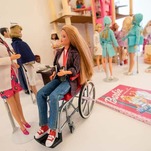
@Mr.Gawn: Actually, if you read the linked article the woman is shown with Barbies in many different forms of dress, including traditional dress from tons of countries, and she also mentions having created a Barbie that was in a wheelchair. I think it's kind of cool to try and make Barbie cross all lines and be many different women.
@Mr.Gawn: Ah, I see. Well, that's true. More shapes and sizes would be better, but unless she cast new bodies for all of them, that won't happen, sadly.
"A non-Muslim dressing a non-Muslim doll in a burka trivializes it and reduces it to a costume as surely as Barbie's Mackies and bikinis and doctors' coats."
Hmm, now this is actually the justification that I've heard by Muslimahs and apologists, that it's just like any other garment(which I disagree with as it is uniquely restrictive and effacing)
A non-Muslim dressing a non-Muslim doll in a burka trivializes it and reduces it to a costume as surely as Barbie's Mackies and bikinis and doctors' coats.
Really? What makes the doll absolutely non-Muslim? Its coloring? Should we be launching a campaign against American Girl for selling Christmas and Hanukkah doll outfits independently of the dolls?
Sadie - Re: the burka being lime green and vermilion
you'd be surprised by the manner of burkas one see's women wearing in europe and the middle east. everything from Fendi logos to gold embroidery head to toe and diamong and crystal studded ones for special occasions - the bright colors are not uncommon, especially at weddings etc!
@rd2uk: Sky blue seems to be the color of choice in Afghanistan. I'd be interested to know if other countries have a majority of burkas or other Islamic coverings in one particular color.
Hmm. Would you, or any of us, have hesitated to comment if the style of dress was not Muslim, but ultra-conservative Christian. Or perhaps the FLDS women with their elaborate pompadours & prairie dresses?
@labeled: I think the religious tenant of "modesty," in whatever form, is an unhealthy way to look at morality. It's not a choice in the same way what I'm wearing today (just a tee shirt and jeans) is a choice. I'm wearing this because it's comfortable and I think it looks nice and cultural norms. A woman who wears modest religious clothing may also make those distinctions, but additionally she's wearing her outfit as part of a religious practice rooted in the idea that there is inherently something sexual (and therefore wrong) about the female body.
Which isn't to say that I think this Barbie was a bad idea, or that women shouldn't be allowed to wear the burqa. Women should be allowed to make their own choices, especially about something as personal as how they dress. But we shouldn't ignore that this style of dress is, in fact, rooted in a patriarchal mindset.
@eatsshootsleaves: I agree. I have, though, become increasingly interested in how we (we as in a largely liberal group) tend to give all things Muslim/Islam a pass, while at the same time, openly denigrate those who practice Christianity.
@eatsshootsleaves: What about a religion such as Amish where both the men and women have a very identifiable and "modest" form of dress?
Also, I think it would be very hard to find a form or style of dress that ISN'T rooted in some kind of patriarchal mindset. How much of the fashion in the US is rooted in that and "looking good" to attract men?
@Red-headed bookworm: I must say that I agree. I grew up in a small sect of Protestantism that did not allow women to wear pants or skirts above their ankles or cut their hair. Men were expected to dress plainly as well and some churches had similar restrictions such as no facial hair or short sleeves. The people in this sect felt very strongly about their dress and would get special permission to wear dresses at work or the pool (oh yeah, the pool). I even remember sermons that advocated for women to quit their jobs if they were not allowed to wear their traditional clothing.
Though I do not practice this dress code now (my family moved to another state when I was starting middle school and there were no such churches in that area), I don't feel that there was anything wrong with the code itself. I've always viewed this dress as what I was always told: that it wasn't as much an attempt to cover up my body as it was a symbol of my faith to people outside and inside of the church.
I think that by simply stigmatizing the burka we are, in fact, looking at it very one-dimensionally and making the women who wear them out to be weak and almost infantile in that they don't really understand what their clothes mean and that they need us, women from the West, to tell them how to dress. Their clothes mean something very different to them than they do us in the same way that I have very different feelings about my traditional clothes than women I describe them to. The issue isn't the burka. It's violence against women. If a woman is forced to do something on threat of violence or death, be is wearing a burka or sexy clothing, that's the problem. The abusive society behind the clothes are the problem, not the clothes themselves because how we dress our bodies mean wildly different things to different, thinking women.
Some of us like to dress in order to show our skin to make a point (that our bodies are natural and beautiful) and some of us like to dress in order to cover our skin to make an equally valid point (that our bodies are devoted to our God and thus clothed in a certain garb). Neither is better than the other.
@countrycomesup: I grew up with a friend who was Pentecostal and had similar rules regarding dress. I also grew up with Muslims who decided to wear a hijab when they got older. I never thought these things were out of the ordinary, just a different way to dress.
I agree that the society behind clothes is more of a problem than the clothing itself. If we stigmatize clothes based on the society they are prevalent in, we'd have nothing to wear. :) I think, for those in the US, it's harder to understand the reasons behind a culture that would wear something such as a burqa, just because it is so different than what you are accustomed to here. You said it well, neither is better than the other.
09:47 AM
12/05/09
In this case, what so many people are doing here is ignoring the context in which it occurs. Black peoples' image has been controlled and outright erased by white people for centuries. These dolls are a tiny step toward rectifying that. Black women have been utterly dehumanized by the way they've been portrayed by white culture, and their voices have been silenced.
I saw one comment that talked about how the commenter worked at a doll store or some such shit. Yeah....on a post about racism. And of course there's trolls yapping about censorship.
12/05/09
Notice, by the way, that if you're a Black woman relating a Black experience, you aren't off-topic, at least according to Jezebel. It's only insensitive white people that want to talk about freckles on a barbie doll that receive the brunt of their wrath. Why? Discussions on race should not be limited to one ethnic group's personal experience. That's why a dialogue, and not a monologue, is so important in furthering everyone's understanding of race relations. It's important for each side to know where the other is coming from. If any comment is dismissive, or misses the point, you can reply to it and insert your point of view. That's what I used to like about Jezebel - that there was a healthy discussion between people of all walks of life. If the editors choose to limit that, then I will no longer visit this site.
P.S. Don't reply with the equally dismissive line, "You obviously didn't understand where Dodai and Latoya were coming from." Trust me, I did, and that's why I'm so pissed off.
12/05/09
So I don't comment. I read instead, I save my empathy for posts where my experience is directly relevant. Having commenting privileges does not mean that I have to comment on everything. Days may go by before I leave another comment on Jez. I read the articles, I consider my response, and then I decide whether I really have something to say.
#blackbarbie
12/05/09
I was a troll to you some time past because, as I am a military wife, you felt I had no business commenting on a post about the military. Never mind that, as someone also employed in law enforcement, I end up knowing a lot about background checks for members of the military. According to you, I had no business on that thread. You are someone who automatically discounts people's experiences based on your personal opinions and whether or not they are saying what you want to hear.
Now, I normally avoid you by not posting on the threads you're involved in, but you have a nasty history of calling out other posters as trolls because you want to police what they say. I don't make thinly-veiled references to your posts and I think it would be a less-hostile environment here if you showed me the same respect. Pompously demeaning someone for "yapping" when you don't like them is starting down the same road as white people trying to silence blacks.
12/05/09
12/05/09
Wow, why on earth could anybody have a problem with that?
12/05/09
Nobody is changing the subject.
As stated before, I read this article, noted it, and moved on.
I only came back to it after reading a pedantic post the following day about how other people's comments weren't welcome.
More importantly, the only reason I left a comment here was because Dodai didn't allow for commentary on her post where it belonged.
I've been posting on this site for over 3 years. I've read enough comments to know when someone is trolling and when someone is trying to relate an opinion and having trouble.
You might try honing your skills before you paint every comment you don't agree with with a broad brush.
09:12 AM
I also find it absolutely hysterical that so many people go, "Oh, so if I DISAGREE with you, I'm a troll, HUH? HUH?"
You're not supposed to sound like an MRA, you know.
09:14 AM
God, stop waving your dick around.
12/04/09
I read this article, and was interested in it primarily because it shows what is RIGHT about America.
Mattel can't make a product line that accurately represents all of America's ethnic breakdowns so it makes a series of dolls it can mass produce. This enrages individualists, and spurs on a side industry of aftermarket dolls
Great! It's a textbook example of the free market at work. It's an example of what this country does well. It also shows that debate about race is healthy for this country.
I check today and there is a post directed at this one, which essentially tells everyone that their comments are embarrassing, and they shouldn't bother to relate personal experiences when talking about race.
Having a conversation about race is nothing without the personal experience. You cannot understand the pain another person goes through in the abstract.
If you don't agree with what someone is saying, you are more than free to do so. In fact that should be encouraged.
Telling them in a post with no option for rebuttal telling them their opinion isn't welcome?
I'm a guy, as such my experience with Barbie is limited. All of my dolls were green, or robots.
I do however have this PERSONAL experience with them.
I worked through my late teens at a Toys R US in Arizona. If you know anything about Arizona, you know the racial makup of the town has a proportionally lower number of Blacks than Hispanics. During the Christmas holidays, we would get several boxes of Barbies, and it was my job for one month to do the "pink aisle."
Each crate of barbies dolls would come with the following ratio: 25 white Barbie dolls, 5 black Barbie Dolls.
Nobody bought the black Barbie dolls.
Towards the end of the holiday season, we would get a rush of panicked grandmothers who would come in and ask, very apologetically, if we had any white Barbies.
I would give a stock answer that "what you see on the floor is what we have", and I would mock them to other employees who hated that question as well.
You see, we were looking at it from the wrong end of the spectrum: We were thinking that Grandma was a racist for not wanting to give her granddaughter a doll that didn't "represent" them.
If I met that kid today, I would have a long hard talk with him about that.
Sorry if I embarrassed you by posting this.
12/04/09
I instead see the post about this as a warning that maybe not everyone should post on every articled just because they can. Read the article, see if you have something to say that furthers the conversation of the article, and if you don't, wait for the next one. But that's just how I read it.
12/04/09
I think it's a little heavy handed though. We already have a moderator, and they have ways of dealing with people who go off topic.
12/04/09
That said, I didn't play with Barbies because they were too damn expensive. :)
12/04/09
12/04/09
12/04/09
12/04/09
Barbie is a toy. And you work at a store that sold toys. And some of the toys had black skin. And some people reacted to the different skin colors of the Barbies. Some showed preferences.
Again, not seeing it. Agree with Latoya and Dodai on this one.
12/04/09
12/04/09
12/04/09
12/04/09
"You are correct in that we cannot judge the intent of others - this is why we say that the *effect* also needs to come under consideration. If you don't intend to kill someone but do it anyway, the end result is a person is still dead. If you perpetuate racism unintentionally, the end result is still upholding a racist system."
I think a lot of people would do good to listen and absorb what Latoya and Dodai and others are saying here, instead of rushing to speak in their own defense. Regardless of what the intent is, I leave many, if not most, Jezebel posts about black women feeling upset, silenced, and annoyed. These feelings are not mine alone and they are real effects of the comments of others. Whatever their intent, the damage they do is real.
You don't owe me an apology, and FWIW, I wasn't talking about your comments from yesterday. I just get the feeling from the general response here that people don't understand where Dodai was coming from.
12/04/09
I'm not here to give an opinion on what it is like to be a black woman in 2009 based on a doll post. Are we going to have a litmus test on who can and cannot comment on a post?
I'd like to know how that is going to work.
For instance, my post shows how you can have something useful to say about the dolls, and how people relate to them without fitting a racial or cultural box.
12/04/09
I didn't even comment on the original post but, even so, it was irritating to log in today and see what was basically a finger-shaking lecture on censoring our own conversations, without the opportunity for a rebuttal by the original commenters who were being criticized. I'd think that if you posted something on the Internet for the whole world to see, you might have a slight expectation that people will comment on it, and comments have a sneaky way of leading to other related topics.
The real problem here is that, in spite of obstensibly standing against censorship, this site censors more than any other I read. I mean, what is the point of writing posts that you want people to read and comment on, only to tell your readers what they should write in response?
12/05/09
12/05/09
12/05/09
But since the article was about reasons why Irby-McBride is facing criticism from the black community, and since the Wall Street Journal extensively covered the issues about race and representation, this was not an article about doll sales - it was an article about perceptions of race and how that impacts the doll. (They did not even touch the sales in the source article.) This is part of the major disagreement - if you don't want to talk about race and culture, fine. But to add comments like that on a post specifically about race and culture is derailing. Saying "this isn't about race, we want to talk about the dolls" when the whole article is about race doesn't really make sense.
12/05/09
Just thinking about that reaction makes me livid because I've had it said to me when I was in a very bad place in my life, and the only message it sends is "You don't matter and I don't care what happened to you. I've had it so much worse." Certain people just have no empathy, and it is tragic.
12/05/09
These dolls weren't made out of some misguided sense of equality, they were made to make money. The criticism, and the aftermarket sales mentioned in your article are direct correlations to business decisions made by this company.
Everything you noted and wrote about could be outlined and used in an Econ 101 class to explain how the free market system works.
Your article might have been only about race for you when you wrote it. The problem is you don't just write for yourself.
If you wanted to write this for a personal blog where you can use your editorial discretion to remove commentary that wasn't specific to your agenda, then you would be perfectly entitled removing or discounting any commentary that didn't follow your narrow definitions.
You didn't. You wrote this, for pay, on a public blog. A public blog with a diverse group of readers. That opens your article up for analysis and commentary.
As I stated before. Race is a personal subject. Everybody has one.
I would not expect you to understand what it is like to be a mixed race Latino male who looks Irish, and wasn't taught Spanish. I could explain to you how the strange hobgoblin of racism rears it's head in different situations when I travel in this country. I would expect you would have commentary about that, and I would expect you would want to relate it to your personal experience.
I wouldn't, however, belittle that commentary or experience by stating that it wasn't good enough, or that it was not on topic. Mostly because that commentary lets me know more about you, and how you relate to the stories I tell.
Hopefully, at some point later on, you will see this as a positive learning experience.
12/05/09
You really need to not unload your irritation at this topic on me, when I've clearly said none of the things you refer to above. If you're interested in engaging with what I've actually said, I'm listening.
09:17 AM
09:19 AM
09:20 AM
09:21 AM
12/03/09
12/03/09
To all the folks who point out that the white barbies don't look like you either - we know. We know that Barbie's measurements are ridiculous, that she puts forth a beauty standard toward white woman that is almost as unattainable as it is for black women and other women of color, we know that molds lend to standardization, we KNOW.
Feminism is full of scholarship about Barbie's impact on white women. It's no fucking picnic for you guys either - we get it.
But it's frustrating to have people keep deliberately inserting their experiences into a narrative that does not fit. It's not the same experience. I can read about what it's like to grow up as a middle class white girl, but I don't live it, so I don't know.
I do know what it's like to grow up as a lower-class black girl whose parents gave her science toys and books to read, and I can only think of owning two Barbie dolls (one black, one Hawaiian) my whole life.
Did Barbie impact me personally? Not really - I wasn't inclined to play with dolls, and I was conditioned to recognize when I was being sold something. I learned from a very early age that white beauty isn't the only beauty and there was no reason to feel bad about some white doll thing when there were so many other cool things in the world.
But that was *my* experience.
My cousin, who had dozens of Barbies and their cars and their dreamhouses thinks Barbies are wonderful toys for her four year old daughter. My cousin jokingly describes herself as looking for a Ken (we are both moving into our late 20s) and keeps her hair long and relaxed.
Unlike my cousin, I never hid under a towel at the pool to keep my skin from turning darker.
And unlike some of my friends, I never felt that sting of being passed over to play with Barbies because there weren't enough black one's to go around. I didn't walk around with a towel on my head swinging it around as if it was long flowing hair, and I didn't (as described in a seventeen magazine article that was published when I was still in the age range to read it) pump out lotion and leave it on my skin pretending I looked white.
I never felt that pain that one of my friends felt when her classmates teased her about having dark skin and short hair, even though it was relaxed and she used a variety of products to try to make it grow.
And I never felt the kind of pain one of my other friends felt when she went up to her white crush and confessed her feelings, only to have him reply "But...you're black." All the parental affirmation in the world was not helping then.
When you have children, you are their primary example. For a while. And then they go to school, they socialize with others, they pick up words, ideas, actions that you never would have dreamed they would. Some of my friends had color struck parents. And some of my friends just got caught up in a glossy, aspirational, media saturated world that paints a very clear picture of who in our society is beautiful and wanted and who is not. Barbie is a part of that. Hollywood is a part of that. TV is a part of that. Advertising is a part of that. And it is relentless and endless.
It might not make sense to some of you who have not felt the sting of feeling entire pieces of your identity excluded from view and representation. Who take for granted that while you may not relate to Blake Lively or Lauren Conrad that you can always turn on the television and see someone of your race and your gender doing all kinds of activities and seen in all sorts of contexts.
If you've never had to hunt for "the one" in media, you are not going to be able to get why Barbie representation is so important to people.
If you felt like you could relate heavily to Daria and Jane but you were still thankful for the one time Jodie made a speech about being the only black kid at Lawndale, if you watched The Craft because it was awesome, but you always remember that it was Rochelle who got told that her "little nappy hairs" looked like "pubic hairs" or you just realized that the only "role"for black girls in society was as the silent/funny/pathetic side kick in a white girl's story then you understand.
This isn't a narrative unique to black women - many, many of us are erased. But the black woman's story is the one I know best because I live it.
If you don't give two fucks about Barbie, great. Bully for you. Dolls don't really move me to action either. But in the context of our society, and how pop culture shapes not only the fantasies that people have but also limits the spaces where they can visualize being, where women grow up to have Disney themed weddings, where Barbie is a global icon, you cannot tell me that a little spit shine and whimsy is all kids need to get over years of conditioning on various fronts that something about them is inferior.
12/03/09
12/03/09
12/03/09
'If you felt like you could relate heavily to Daria and Jane but you were still thankful for the one time Jodie made a speech about being the only black kid at Lawndale, if you watched The Craft because it was awesome, but you always remember that it was Rochelle who got told that her "little nappy hairs" looked like "pubic hairs" or you just realized that the only "role"for black girls in society was as the silent/funny/pathetic side kick in a white girl's story then you understand.'
That's why. That's me (as a youngun' anyway). You write insightfully and humorously about all sorts of things, race included, and you create opportunities for discussion about perspective, compliance, and personhood, and a whole host of other topics that wouldn't get talked about. I appreciate that, especially from someone who has shared experiences that are similar to mine.
12/03/09
12/03/09
12/03/09
12/03/09
One thing some white feminists have to learn is to just LISTEN sometimes and not try to colonize someone else's narrative or experiences.
"Kids used to make chinky eyes at me and my brother. They'd make ching-chong noises at us sometimes."
"Kids used to make fun of my freckles and red hair. They used to make fun of me with fake Irish accents."
These seem like similar experiences but they're not the same. The former is imbued with histories and meanings that the latter isn't (at least, not nowadays). Treating them with equal weight conceals those histories and meanings.
That's not at all to say that white women are a monolith, either. Or that that obviates the ability for sisterhood and coalitions and all that good communal stuff. But the taking over of conversations started by women in disadvantaged positions within the feminist movement by those who are more advantaged is a trend I've definitely noticed in the comments.
Listening (or reading, I guess) can be just as or more supportive than chiming in all the time.
12/03/09
I agree, the dolls need more variation on skin color, hair texture/length, and eye color. However, there are PLENTY of Black girls who look just like these these dolls. Their hair is naturally curly, wavy or straight, skin naturally light or caramel or sepia toned, eyes naturally lighter brown to green to blue. Are we really saying that since these dolls aren't "Black enough", then neither are those Black girls who look that way either?
Trust, I hear you on this issue. What concerns me is that in a effort to include everyone, we tend to exclude some.
12/03/09
I am sorry that you felt that way growing up. I have no idea what it was like to feel so excluded or different because of your skin. I am a white woman from Georgia. I grew up in a trailer park, and most trailer parks, let's face it, are full of poor white people.
I was even a little blonde girl. When I was little, I preferred the dolls that DIDN'T look like me. I didn't like Barbie. I liked the red head, the "hawaiian" doll, and the black doll the best. I didn't like my dolls looking all the same. Not that then it was a political statement.
I think it's pretty shitty to be a child and not see representation of people like you in the media, or around you. I have no idea how alienating that is.
I was ashamed of my poverty, of the popular pretty girls shrieking "YOU LIVE IN A TRAILER PARK?!?!" in the lunch room, and laughing at my free lunch card, my clothes, my hair. Black, white, all the popular kids picked on me off and on throughout my early childhood.
And I know I felt like shit. So I'm pretty sure what you went through was heartbreakingly awful.
I'm sorry for it. I wish that things were different. I wish that people didn't think someone with darker skin was automatically not pretty. It's ridiculous, and a child shouldn't be shamed for their body.
...this is really long and crappy, but hey.
Great post. I appreciated being able to read it, and I hope I got my meaning across.
12/04/09
12/04/09
12/04/09
You mentioned generalizations - one of the things that some of us in various groups use to connect and discuss is a commonality of experience. Racism has an uncanny way of acting out the same behaviors over and over again - therefore, there is a higher probability that many of us have experienced racist dynamics at play. There's a big difference between that and flattening an experience by denying that there are systemic issues of racism that may influence why people feel so strongly about accurate representation - or, overwriting the shared commonality of these experiences since they don't directly match up to your own.
12/04/09
In a few words, no, we do not want to exclude anyone. Our groups are not monoliths, and the discussion threads over there a lot of people identified as looking like some of the dolls even though they do not identify as multiracial.
However, the issue of representation is a difficult one, which is why I directed readers to the Mattel site. Irby-McBride makes a point of discussing why she was motivated to make these dolls - representation. She specifically discussed having broader features on the dolls, which she felt represented a look that more black girls can relate to. However, she then launched into an explanation of why "it's more fun" to play with a doll with long, straight hair - and market reasons aside, that could be problematic for many parents. That's why those things were pointed out.
I was also interested to see that the other doll modifier set upon the dolls and immediately changed eye color and hair texture, because she thought those changes would be more representative. As I wrote, neither of them were happy with current representation, so they both, in their own ways, set about changing it.
12/04/09
Preach.
Please keep writing. I enjoy reading your pieces for Jezebel.
12/04/09
I think the danger of de-valuing another person's parallel that would otherwise allow him or her to empathize with how you feel (i.e. "I know how it feels to be picked on and judged for your looks, I was the heaviest kid in the third grade.") is that you put your experience into some compartment where it's untouchable and unrelatable. And you prevent other people from learning how to better bond with you and how to manage their behavior to offend you less, because you deny them the opportunity to relate.
12/04/09
The early feminist movement was pretty upper class and white, and it's only in recent years, among this 'Jezebel generation', that feminists have consciously tried to include other voices besides those of relative privilege. It sucks that everyone seems to have that overwhelming human urge to empathize to any post by relating to their own experiences, but it's part of the larger discussion, and it's in that back and forth people can come to understand that such interaction can sometimes serve to diminish and patronize the person telling the story.
But it's important that these stories, and the subsequent discussions, continue, because it can't be feminism without hearing, respecting and being fundamentally shaped by the voices of black women. (And Asian. And Hispanic. And gay. And white.)
12/04/09
12/04/09
This kind of dynamic happens often on my blog. A person who is may not be of a the race/ethnicity being discussed shares a story about their experience. It is not the same. However, there are two very different ways people go about it.
One is when someone is trying to *affirm* an experience by relating it to their own lives. They talk about marginalization based on their sexuality, or based on their race gender combination (for example, many Asian American males and African American females find common ground in being portrayed as undesirable partners in the media). The experiences of an Asian American male and an African American female are not the same - however, there are enough notes of similarity where when we write a post, someone wants to reach out and say, "hey, I feel you on this - you are not alone."
The second is when someone is trying to *deny* your experience based on their limited reality. This is what I object to, because they are building what is a false parallel. So, comments like "As a white woman with kinky hair, I think it's ridiculous that black women wouldn't want to straighten their hair! I straighten my hair to look presentable and so should you!" (We actually received that comment on Racialicious, but it went on for paragraphs). It is frustrating when you are talking about a large, systemic issue and people try to make it about the individual. Saying "well, my barbie didn't look like me either" or "women in ads don't look like me" as a way of dismissing the systemic in favor of the personal actually stalls conversation.
And to be frank, its one of the reasons that Racialicious focuses our comment mod policy the way we do - our readers hear that shit all day long. They want a space in which the participants are already aware of the differences between systemic and individual acts of racism and can discuss them intelligently. (And, for some reason, our white readership on the site manages to participate in these convos just fine.)
Is this a large issue in feminism? Oh yes. But the frustration comes not because people just *aren't aware* of these differences - it is because when you present the facts, that are too busy navel gazing to listen.
12/04/09
I just wanted to say that I hope you do continue to write about race for Jezebel. You're an excellent writer you contribute greatly to this site. I grew up outside of DC, raised by two extremely liberal parents who believed that the greatest lesson I could learn was that everyone was equal. I played with both black and white dolls as a child at my mother's insistence. I was an African Studies major in college, I've lived in South Africa. But you know what? I still know nothing about the African-American experience. Reading Jezebel has opened my eyes to everything I still have to learn, much of which I'll never understand because it's not my experience. But that's the beauty of this site, and of your contributions to it, I get to sit back, listen, and learn. I've been confronted constantly with my understanding of race and ethnicity in ways I could never have imagined. So please stick around, I appreciated being confronted. It's the only way to move forward.
12/04/09
If the attempt ends in failure, does it mean that the writer's effort to understand wasn't worth it? Maybe it does. But shutting people down--censuring them for "not getting it"--discourages people from trying again.
I get it, I've been there: it's tough to watch someone treat lightly an issue that you consider very serious and personal. But people are self-absorbed by nature and by necessity: I'm not going to be passionately concerned with factory conditions in Cambodia if my own life is falling apart. I just don't have the mental energy for it. It's one thing to ask people to be respectful of different ways of life; it's another thing to ask them to put their own thoughts and experiences aside while doing it. I'm not saying that people aren't morally obligated to try--but I am saying that they're not morally obligated to succeed.
Latoya writes: But the frustration comes not because people just *aren't aware* of these differences - it is because when you present the facts, that are too busy navel gazing to listen.
To which I say, true: but can you ever understand another's experience outside the context of your own? That's what empathy IS: we can only be empathetic to others to the extent that we can see their experiences as contiguous with our own.
This discussion has made me reconsider remaining on Jezebel. Not Latoya's post itself, but Dodai's response (which I can't respond to, so I'm addressing it here). It's one thing to say that "you're not understanding an issue." It's another thing to say "Your experience as an [Asian, European, Hispanic, immigrant, etc] isn't relevant to this discussion, so it isn't welcome"… especially since Jezebel doesn't provide equal opportunities for these other groups to talk about their experiences. And what if they did? Would we just segregate people, so that all the white people read certain threads, and all the blacks read others, etc, etc?
According to my secular humanist values, it's important to acknowledge differences among people, but it's more important to nurture similarities. Real understanding between people is incredibly difficult, and for that reason, it's important to accept partial success, meet failure with patience, and, most importantly, to NOT SHUT DOWN other's thoughts and opinions. So, I think I'm done here.
12/04/09
12/04/09
On an individual to individual level, this is painful. On a societal level, it is catastrophic.
Some people have endless fountains of patience to continue to challenge the same prejudiced ideas over and over again. But many of us do not. This is not the first time I've encountered any of the lines of argument above. And while, on an individual level, it seems fine to try to engage someone with conversation, over time, those of us who are in a historically marginalized group find ourselves arguing the same points over and over again in an endless loop. Sure, it's cool the first three times you explain something like this. But the 300th? 3000th? There is a reason why many people blogging about issues of social justice maintain that members of marginalized groups have no obligation to teach anyone. Why? There are millions of blog posts, thousands of books, discussion notes, podcasts etc, dedicated to explaining any thing you want to know. Asking people to continually perform on demand is demoralizing.
It is as Mai'a writes here:
in my experience, folks can learn all the theory, all the right words, all of it and yet act fundamentally the same, live out the same patterns of thoughts, still hold the same fucked-up priorities. and yet spout all of the anti-racist rhetoric.
because that is all it is to them. rhetoric.
people only learn as much as they are willing to learn.
and anti-oppression is not complicated. you dont need to read a book or a take a training or read a blog to learn humility, respect, and love. [...]
i guess what i am saying is that in my experience if white folks want to be respectful of poc or understand where they are coming from–they dont need a workshop. there are centuries of writing from poc that they can dive into. there are plenty of poc in their neighborhoods and community organizations. when white folks are ready to be anti-racist, when they are ready to turn from facing the center, to facing the margins, and stand with us. we will be here
Sharing of ideas, conversation, open-discourse do not work if people reject the reality of others in favor of maintaining their ideas about the world. No one is saying that this isn't difficult or complicated. We all have moments when we fail. We all have moments when we stubbornly refuse others the empathy we crave for ourselves.
However, we are also operating within a system that rewards this micro acts of prejudice. And I don't see the point of engaging, endlessly, particularly if people don't really have any need to change. I can call myself a gay ally until I am blue in the face, point to all the posts I've written or deeds I've done, but it would not change the fact that I, as a heterosexual, will never be the target of that specific brand of prejudice. And as such, maybe I should be careful of trying to insert my hetero-narrative into a context where it doesn't fit.
At the end of the day, I can walk away from the conversation and go about my life. Others live it. So, in general, it is a good rule of thumb to tread lightly. For some people it is a thought exercise, for others, this is their lives. And while I value my opinions and perspective, it is important to remember that everything is not necessarily about how I see things.
Jezebel has very different norms from Racialicious, and I voiced my anger precisely because that is the way you all do things here. Over on Racialicious, we do it very differently. There aren't really conclusions to be drawn from that, but I do find it interesting that on black barbie posts or black hair posts or various other posts, the same arguments manifest time and time again.
Some people have mentioned this exchange has been helpful to them, and I am glad for it - however, I should clarify, so people do not continue to worry.
I do not wish to write about race for Jezebel. Where I am, and where I focus my activism, I prefer to work with other people who recognize the issues with systemic vs. individual racism, and are interested and willing to compare the ways in which oppression impacts us in order to raise a stronger fight against it. I've written about race daily for a solid three years now - I know what I want to accomplish. I just spent three or four hours I could have been doing other things responding to people's concerns, and while that is fine sometimes, it isn't a sustainable practice.
Since I, like everyone else, do not have the luxury of single issue. I will still write here for the other things I am passionate about. But I don't feel the need to engage all the time. My writing, the writing and speeches and talks of others, all of that are around if people want it. But I firmly believe that you will not change anyone's mind about anything unless they are willing to hear it.
You are correct in that we cannot judge the intent of others - this is why we say that the *effect* also needs to come under consideration. If you don't intend to kill someone but do it anyway, the end result is a person is still dead. If you perpetuate racism unintentionally, the end result is still upholding a racist system.
But I am not overly concerned about this. I am one person, working at something that millions of others did before me and millions of others will do after I am gone. I do what I can.
And if people find my ideas intriguing and want to subscribe to my newsletter, they know how to find me.
12/04/09
The hair issue is a beast, though. There is a cacophony of opinions from within the black community on 'good' hair and 'natural' hair that white and asian (and most Latina) women just do not understand. A non-black woman with curly hair does not face the same potential statement of politics and culture with her hair style as a black woman does (if anything can be seen as a near parallel, the choice of covering ones hair in Judaism and Islam comes close as a visual signifier on such things). And it gets old, both the insistence on intimately understanding and the idea of straightened hair being more 'presentable' somehow.
But, if anything, the constant debate might allow some reasonable people to learn how to listen, and not always thinking the commenting equivalent of what they are going say while someone else is talking. (Hope that metaphor holds as well in print as it did in my head.)
And, my larger point, which I'm not sure if I made as clearly as I could, is that the constant need to relate, while humane and admirable, gets in the way a lot, and especially within the history of feminism, tends to subsume minority voices. And I think that by doing what you do, while it may seem like rolling a rock up a hill sometimes, will eventually wake some people up, and make for a greater diversity in this loose federation of women, and hopefully, get us somewhere better than where we are now.
12/05/09
Or worse, "Well I didn't experience life that way, so your opinions on your own lived experiences and the lived experiences of people in the group you occupy are invalid."
If that's all people have to say? Then they can kindly keep quiet.
12/05/09
But I honestly believe that in a forum where the goal is thoughtful communication and understanding, part of what is happening, and what is making some commenters so angry, is the devaluing of personal experiences that they offered up in a spirit of honesty in what they thought was a trusting and loving environment. And, by the way, when that personal experience is something that still evokes pain and sensitivity, and something that has become a part of you, rejecting that experience as a valid contribution is kind of like rejecting you.
Let's all cut each other some slack. Let's assume that when we share personal experiences, we're trying to be relevant and we're trying to further the conversation, not derail it. I haven't read 100% of this thread, given how much it's grown, so I'm sure there are comments here that I would think don't belong. But most of the ones I skimmed seem genuine, and I would much rather have them all come out, and have us discuss and correct people's perceptions where need be, rather than shut them up, make them feel angry and irrelevant, and have them internalize that anger and continue to relate poorly.
12/05/09
Effect matters every bit as much as intent. If you're (the indefinite "you" here, not you personally) a galumphing clutz who steps on my obviously-in-a-cast-and-badly-broken foot while trying to help me with my groceries, yeah, it's nice that you tried to help, but my foot's still broken and you just made it worse. And if I tell you maybe you should be a bit more careful next time and you get offended and go "Gosh! I was just trying to help, where the hell does she get off?" you look like a jackass. It's not the same intent as you walking over and deliberately stomping on my foot, but the effect is still the same. So what we're saying here is, thanks for the attempt, but people are stepping all over our broken feet, and if they are sincere about helping, then they need to step back and learn to be a bit more careful.
12/05/09
I hear you. I think we're really saying the same thing. But next time, if I step on your feet, I'd really like to know about it and have a chance to learn from my mistake!
12/03/09
Come on y'all. Everyone is talking about hair, but the 2 main activities my Barbie engaged in were 1. grinding against each other naked and 2. trying on clothes.
12/03/09
... I never liked Barbie as much as her friends.
12/03/09
If we look at this from a strictly financial perspective, wouldn't Mattel focus on lighter-skinned black dolls because within the Black community it's often valued more? In this sense, if they were to create a more accurate depiction of Black women, girls would not want them because there would be no element of "aspiration."
Does that make sense?
Also, absolutely not saying this is okay, just thinking about how they may have looked at it.
12/03/09
12/03/09
12/03/09
12/03/09
12/03/09
There are many different dolls Mattel did towards an African American Barbie...
[www.amazon.com]
[www.amazon.com]
[www.amazon.com]
Also if you go to this link [www.barbie.com] it shows the true color of the Barbies and they come in three different skin tones, from dark , medium, light skinned.
That cartoon image does not do justice to what the dolls look like.
12/03/09
12/03/09
Mattel's goal is to make as much money as they can; in a cost-benefit analysis, there is very little benefit in creating dolls that will not sell well for many years (if ever), in order to nuture the developing senses of self of their young consumers. Dolls that represent an unattainable "ideal" of beauty will sell better than dolls that are a more accurate representation of the human body, and it's more complex beauty, which I think is an important factor: Younger children tend to seek out simple, smooth, symmetrical planes when scanning their surroundings; objects with those characteristics tend to become what the child would identify as attractive -- human faces (and representations thereof) included.
The cultural system (that transcends race) in this country favors a feminine ideal that revolves around a certain body type, and certain length and abundance of head hair (though texture may vary, if you're going to fit the feminine ideal as it is presented your hair should be long and very thick), and very little body hair, if any, anywhere else. Girls of all races respond to *that* ideal, before -- in my opinion -- they begin filtering information about "preferred" skin color, eye color, etc. In other words, yep, from a consumer-driven standpoint, the product has to be "aspirational" to make it marketable; but I think, at base, those "aspirations" are a bit more broad than simply "light skin, straight hair."
12/03/09
12/03/09
12/03/09
The black community I grew up in very much so favored lighter skin color and straighter hair as indicators of social and economic status. The black community that existed in the town where I went to University, however, did not place as high a value on those traits, if there was any placed on them at all. Different states, different parts of the country, and very different ideals in terms of what is considered "locally ideal".
12/03/09
12/03/09
I am a short white girl with wide hips, close-cropped hair and glasses. About the only thing my beloved Barbie with big boobs, long limbs and shiny blonde hair had in common was a love for sparkly clothes and hot Corvettes. My MOTHER taught me to love the skin I'm in - frizzy, coarse hair and all - not Mattel. Nor did my mother expect a toy company to teach me much of anything other than how to make awesome outfits out of scrap fabric and safety pins.
Parents/siblings/awesome aunties do more for a girl's self-image if they get down on the floor and play Barbie with their daughters rather than assuming that the doll in question is undermining body image/brain development to any measurable degree.
Barbie is not a gateway drug - black or white or Latina. She is simply a toy. The questions in our daughters/nieces/sisters heads may begin with her but they don't END with her: They end with us.
12/03/09
12/03/09
12/03/09
Is Dora an accurate representation of Latina pre-schoolers? Of course not. She's a GOOD representation b/c she's a problem solver, a good friend, etc, etc. But even she's not perfect - she can't represent EVERY Latina experience. She's a cartoon.
Again, my Barbie and I had nothing in common but I loved her and I played with her...and I didn't go and get a boob job or dye my hair blonde.
I have a feeling that African American girls will end up at the same conclusion - Black Barbie is fun even if she doesn't look like me.
12/03/09
12/03/09
12/03/09
I wanted to be Christy Brinkley and then Christy Turlington. My mother probably wanted to be Twiggy and Lauren Hutton. My nieces probably want to be Taylor Swift or Ariel.
We will most likely never quell a young girl's desire to be something (anything) other than what she is. Fantasy (and disappointment and acceptance) is a part of growing up and growing old. Dolls happen to be an essential part of that growing. Rarely are they an accurate representation of anything other than a company's bottom line.
12/03/09
12/03/09
My children are going to be biracial and I'm really glad to read about these smaller doll makers and know there is a place to get my kids dolls (if they decide they want to play with dolls) that look at least a little more like them.
12/03/09
I'll use a personal example (anecdotes are not facts I know, but hear it out). I got a perm at about 8-9 because my mom decided my hair was too "unmanageable." There was never any real mention or consideration of a natural or natural based hair style in my home. (My mom has a thing against dreads, and as an HR person doesn't see afros or "unruly" natural hair as viable from the stand point of "marketing yourself") My hair has been straightened ever since (with perhaps a few summer braid stints), and as of late I've been having more trouble with maintenance because, well, shit's expensive. I'm considering going back to my hair's natural state. But it's hard; I know I don't really have my mom's support, and I don't even have anyone to tell me what I'm supposed to do. I do not know how to care for my hair in it's natural state. And I think that's a larger issue than whether or not I had a Barbie with straight or curly hair/ dark or light skin.
If you create a network of support and understanding surrounding natural hair and straight hair, it won't matter whether they choose the former or the later. You have done your job to let them know who they are and how they fit into the world, both in a natural and in an altered state. Of course from there they'll make their own decision, but at least they'll be armed with knowledge.
I think this applies to any discrepancy between real people and fantasy (toys, films, etc). You aren't going to be able to eliminate the imperfections in our culture (at least not anytime soon), so the best we can do is try to perpetuate a comprehensive knowledge of the world and the people in it beyond how they're portrayed in the media.
12/03/09
And it's important to note that while Barbie is a fantastical, unreal looking doll, she is still a blonde, white, tall, skinny, buxom woman. Those people exist, and our beauty ideals revolve around those images. If she were a green toaster-shaped alien, then yes, she would clearly be a thing of fantasy. But when the Barbie doll, a fashion and beauty doll designed to be dressed up, makeuped, and styled, and who is supposed to (and does, take a look around) define the ideal beauty, looks like a real person could look, and you never see your features represented in "things that are supposed to be beautiful" (fashion dolls, actresses, models), you start to realize that people of color are never included in these "things that are beautiful". You doubt your own looks. Your race itself is what makes you ugly. If only you were white, you'd have at least a chance at people thinking you were/being pretty. It's not "I wish I looked like Megan Fox because she's so pretty." It's "I wish I weren't ____, I wish I was white, because at least I'd have a chance of being [what society considers] pretty."
12/04/09
As for the hair issue -- you raise many good points. I suppose the bottom line for me is that I find it disconcerting that someone would choose to straighten their hair because they find the texture of natural black hair to be ugly and irredeemable. It's the reasoning, not the style choice, that bothers me -- especially in young girls.
12/04/09
12/04/09
We're making assumptions of each other's personal, childhood/developmental struggles in a "mine was worse than yours" kind of way. If I came across as doing so, I apologize. It wasn't my intent.
I read the original post as questiong why Mattel didn't do more to make a wider range of Barbies. But Mattel's aim is simply an attempt to tap into an under-served market for - above all - profits; not because they want to champion the self-esteem of anyone. That's what American Girl aims to do (while earning major profits as well, of course), with Josephina, Kaya, Addy in a "make your ethnically diverse purchase by clicking here..." kind of way.
Your overall point is well-taken: the very fact that I am white made it possible for me to "enjoy" a doll that catered to my race rather than ignoring that fact that I even existed; I didn't have to question my skin color while playing with her.
Even if I was measuring my own attractiveness against Barbie's buxom frame, blonde hair and clear skin, I wasn't burdened with the deeper question of whether my skin was "good enough".
I still contend that Barbie (black, white or otherwise) gets a bad rap at times for something that society has to address on a much larger level.
That kind of venom should be saved for Bratz as everyone knows those girls are tramps!
12/04/09
I get the importance of having even that slim bit of commonality (Barbie's and my skin color) and that it shaped how I thought the world viewed me (as good or fair rather than bad or too dark).
I read the original post as complaining that Mattel wasn't doing enough to make a wider array of black dolls to appeal to the broad range of African American types. I took issue with the fact that Barbie is in a lose-lose situation when she should be just a doll: She's damned if she's white because she's "obviously" a slutty, dumb blonde and damned if she's black because she's not black enough.
Mattel's profit margin hasn't allowed much room for promoting positive self-esteem. That's why they bought American Girl company...the ethnically diverse $431 million-in-sales ying to their Barbie yang.
12/03/09
Plus, they always have the same damn face. Button nose, full (not big) lips and HUGE eyes. No matter the color, she looks the same.
12/03/09
Boys get the R/C car because their parents won't let them drive. Girls get rocking ponies because their parents can't afford to get them a real horse. Kids play with big dollhouses because they don't live in fancy mansions. And they play with the long haired and uber thin dolls because they will never look like that.
That difference makes up for the rather significant failing of toys in that they are not real.
12/03/09
12/03/09
12/03/09
Imagine what a line of dolls depicting athletes. Imagine a line of dolls depicting business executives. Imagine a line of dolls depicting super-heroes. Imagine a line of dolls depicting a detective crew. None of them would look anything like Barbie. If Barbie or Ken dressed up to be any of those roles, they would look exactly like that - as if they were dressing up for the roles. Barbie doesn't ride a horse. She dresses in a riding outfit. She doesn't play golf. She wears a golf outfit. She doesn't go to a rock concert. She dresses like she's going to a rock concert.
Barbie was designed to be the doll that dresses up. She doesn't do anything other than wear clothes and have hairdos. And, over the last fifty years, Barbie has actually managed to become the symbol for all women of what someone who stands around looking pretty looks like.
One could even argue that Barbie has done a lot more harm to those women who actually resemble her because they can never be taken seriously. If you look like Barbie, people think of you as Barbie. You wear pretty clothes and have pretty hair but you don't *do* anything.
12/03/09
[www.gogosportsgirls.com]
However, I will bet that they don't sell nearly as well as Barbie.
11/23/09
jus make it more realistic to ACTUAL humans, my only issue with it
11/23/09
11/23/09
like i was saying, my main beef is how fake barbie looks...
so to have a more multi-cultural looking barbie, in all shapes and sizes.... would work for me
#tips
11/24/09
11/23/09
Hmm, now this is actually the justification that I've heard by Muslimahs and apologists, that it's just like any other garment(which I disagree with as it is uniquely restrictive and effacing)
11/23/09
Really? What makes the doll absolutely non-Muslim? Its coloring? Should we be launching a campaign against American Girl for selling Christmas and Hanukkah doll outfits independently of the dolls?
11/23/09
11/23/09
you'd be surprised by the manner of burkas one see's women wearing in europe and the middle east. everything from Fendi logos to gold embroidery head to toe and diamong and crystal studded ones for special occasions - the bright colors are not uncommon, especially at weddings etc!
good choice not become fox news fodder, though.
11/23/09
11/23/09
11/23/09
@labeled:
11/23/09
11/23/09
Which isn't to say that I think this Barbie was a bad idea, or that women shouldn't be allowed to wear the burqa. Women should be allowed to make their own choices, especially about something as personal as how they dress. But we shouldn't ignore that this style of dress is, in fact, rooted in a patriarchal mindset.
11/23/09
11/23/09
Also, I think it would be very hard to find a form or style of dress that ISN'T rooted in some kind of patriarchal mindset. How much of the fashion in the US is rooted in that and "looking good" to attract men?
11/23/09
Though I do not practice this dress code now (my family moved to another state when I was starting middle school and there were no such churches in that area), I don't feel that there was anything wrong with the code itself. I've always viewed this dress as what I was always told: that it wasn't as much an attempt to cover up my body as it was a symbol of my faith to people outside and inside of the church.
I think that by simply stigmatizing the burka we are, in fact, looking at it very one-dimensionally and making the women who wear them out to be weak and almost infantile in that they don't really understand what their clothes mean and that they need us, women from the West, to tell them how to dress. Their clothes mean something very different to them than they do us in the same way that I have very different feelings about my traditional clothes than women I describe them to. The issue isn't the burka. It's violence against women. If a woman is forced to do something on threat of violence or death, be is wearing a burka or sexy clothing, that's the problem. The abusive society behind the clothes are the problem, not the clothes themselves because how we dress our bodies mean wildly different things to different, thinking women.
Some of us like to dress in order to show our skin to make a point (that our bodies are natural and beautiful) and some of us like to dress in order to cover our skin to make an equally valid point (that our bodies are devoted to our God and thus clothed in a certain garb). Neither is better than the other.
11/24/09
I agree that the society behind clothes is more of a problem than the clothing itself. If we stigmatize clothes based on the society they are prevalent in, we'd have nothing to wear. :) I think, for those in the US, it's harder to understand the reasons behind a culture that would wear something such as a burqa, just because it is so different than what you are accustomed to here. You said it well, neither is better than the other.