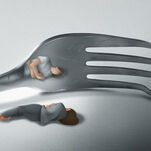
I think my husband may have this but since he has the metabolism of a hamster on crack nobody notices. You should see him at night when he gets home. WHAT CAN I EAT?! WHAT ELSE CAN I EAT?! I basically have to make sure there's about three meals ready for him or he'll just wander around the house all mopey.
I've had "issues with food" as long as I can remember, but I've never had an eating disorder -- or rather, I've never been anorexic or bulimic. There's a good chance I'd qualify as having (had) binge-eating disorder if it were recognized. I've been mostly okay since September (although relapsed a bit this weekend) but this summer was a turning point.
Went to the doctor at the beginning of the summer with talk of anxiety/depression and binge-eating problems. I said I thought I was a binger. He asked me if I purged. I said no, but it was like bulimia without the purging. He said then I was just normal, having the same problems as anyone. He then said I should eat better and exercise more to make the anxiety/depression go away.
He trivialized my problems and made me feel like I was just lazy. I knew it wasn't just simple over-eating because I know the psychological component that goes along with it. The self-hatred, the self-punishment, the pain both physical and emotional, the secrets -- eating the middle of the night, trying to hide the evidence --, the bargaining, the self-deception and denial, the crying, the speed, the desperation.
If this were legitimized I wouldn't have to rely on vague euphemisms with friends, or persuasion techniques with therapists to try to get them to take this shit seriously.
(I think the doctor's a lost cause though, seeing as he's the same one that just told me I'd "get over it" after I asked for a therapy refferal after getting out of an abusive relationship that involved stopping a suicide.)
@superconnected (is it time to leave?): Once, I saw a psychiatrist who told me I was "just being a rebellious teenager" rather than suffering from clinical depression/anxiety/PTSD/ whatever else. I don't exactly know what was wrong with me, because noone ever told me, all I know is, I didn't TRY to be that way, I just could not function like a normal person.
How would you feel if someone close to you binge ate? You would want to help them, yah? Well, then that answers the question.
I'm not trying to trivialize this issue in any way, shape, or form. I read the article and I'm shocked that the DSM doesn't recognize this as a disorder. I'm shocked and saddened. And angry that someone might not get the help they need.
@MediasBlue: lol. "How would you feel if someone close to you binge ate?" considering the rate of obesity in the US, chances are everyone knows someone who binge eats.
It absolutely is. In fact, I have long been confused that compulsive/binge eating has not been diagnosable as an ED. Bulimia (for most) is essentially binge eating with purging behaviors.
@Penny: That's why a lot of recovered bulimics tend to be overweight. Whereas anorexia recovery involved forcing yourself to do something, bulimia recovery is at first resisting the urge to do something (purging). It's extra hard to stop the purging AND binging.
@scarletbegonia: Yes, this is what's very unique about Bulimia. I tended to not binge but simply purge when I felt that I had eaten too much (i.e. finished a full portion at a restaurant). This still flares up occasionally and most of the time there is no catalyst aside from a "ding ding" moment in my head urging me to get rid of what I'd just eaten. Bulimics tend to stay at a normal/average or above weight, with can make the disorder hard to see by visual identifiers alone, but it's still as dangerous as Anorexia.
Not to mention the intense shame that comes with Bulimia, which is a big differentiating characteristic between it and Anorexia. Not only does society reward control and, really, the physical changes that come along with controlling one's intake of food.
I have a close friend whose sister was raped in college. For the past 6 or so years she has gained a great deal of weight due to compulsive overeating. This, in large part, was due to her wanting to repel men around her and control her body. Really, in the opposite way that an Anorexic would. No one could tell her how she should appear, she decided it for herself, and while it was damaging, it did empower her to a certain degree.
There's no difference, in the overarching issues, between the three ED scenarios, in my opinion.
@Penny: I've had the same issue - wanting to purge after eating a "normal" amt of food, but also struggled with legit binging.
It's also very interesting to bring sexuality into the mix. I feel the urge to revert to anorexic and restrictive behaviors to guard against feeling objectified (if I don't show secondary sex characteristics, men won't bother me).
I love that this thread has exhibited a level of compassion and empathy from commentors who've struggled with different and multiple EDs.
@scarletbegonia: When I went through a 2-3 year period of trying to control my eating via exercise and food restriction, it was for the same reason (guarding against being objectified). Sexuality is a very important element to the development of EDs, I believe.
Yes, Jezzies are great for the compassion and empathy :-)
@scarletbegonia: " I feel the urge to revert to anorexic and restrictive behaviors to guard against feeling objectified (if I don't show secondary sex characteristics, men won't bother me)."
I understand that completely. A large part of my motivation to be anorexic in the past has been in an effort to "loose my breasts". As it turns out, my breasts are very dense (that is a greater gland to fat ratio) so loosing weight makes almost no difference in my large breast size. I've longed for a breast reduction since I was 12, in part because of the physical discomfort, but mostly because of embarasment over my sexuality (or how I'm sexually perceived by others.) I feel "exposed" even when wearing a turtle-neck. I've suffered quite a lot of sexual abuse in my life. I know this is a huge factor in my negative issues with my body.
I really sympathize with you.
And I too am so glad for these discussions on Jezebel. This is part of what makes it such a special website.
@Penny: Yes, sexuality certainly is an important element. I developed anorexia at 12 and I believe very firmly that the repressive Catholic environment I was in and all the sexual shame that can accompany that was a huge part of it.
@scarletbegonia: I don't want to make any universal statements, because everyone is different, and everyone's struggle with ED is also different, but it's such a relief to see people here who have had similar experiences. I was raped when I was 16, and my problems with eating started within weeks, and there's no way those two things aren't related. I think on some level I knew that what I was doing to my body was wrong and unhealthy and not normal, but I didn't care. I wanted to systematically destroy myself. I was too afraid to actually open up and tell people what had happened, but I wanted my outsides to match my insides. I wanted to look as ravaged and depleted as I felt. The world as I knew it had been turned upside down and no longer made sense, and I started trying to regain control where I had lost it the most - with my own body.
Having a label is more important than a lot of people think it is. It validates the problems and externalizes them to some extent. It's not just all in your head, you're not just making it up or out of your mind. Having a label for what you're dealing with gives you something tangible to grasp and to work with. It stops being something nebulous that's floating around in your brain and becomes a simple fact about your life that can be summarily dealt with.
Out of curiosity, how did relationships fit into ED and recovery for other people? If anyone else was in a relationship while they were either in the midst of or recovering from ED, how did that work for you? You'd think it'd be some kind of external validation, but not quite, and I'm just curious to hear others' thoughts on this.
@sanssoucis321: When I recovered, my only real relationships were with my family, who had shown frustration, sadness, and guilt as a reaction to my ED but were very supportive in recovery.
A year or so after I started dating my first and only boyfriend. He's gone through periods of being almost ready to quit and upset since I can't really look at food in a normal way, but tried to be understanding.
Occasionally my fear and disgust about sex will carry over to him, and that causes a lot of tension, but I'm learning to look at it with him differently than just "ew, guy who wants to touch me," since it's out of love and not objectification/primal urges.
FYI, I have never been sexually or otherwise abused, but I think my feelings about sex stem from wanting to revert to childhood in a sense with the ED. I can't imagine dealing with abuse, so I admire your strength. Many hugs from me!
@sanssoucis321: Wow. I'm in the midst of recovery right now, and am also having to deal with a bf who is "supportive," but recently confessed to me that what first attracted him to me was my confidence. The subsequent revelation of my ED and obvious anxiety/low self-esteem has made him withdraw and..."not able to love me."
I'm not sure how to handle it. I'd rather manage one thing at a time. I'm going to a counseling group and in a few months I'll be in a home where I can deal with my ED exclusively. In the meantime, it's like I'm living two lives...super-confident Dr. Girlfriend, and terrified girl with an ED.
I'm so thankful that I have a place to share my frustrations, and to hear the stories of all my fellow Jezzies.
I'm bulimic, and during binges I eat enough so that it physically hurts me. Even if I can't purge (losing my gag reflex, yaaay) I still feel like I've accomplished some sort of goal because my ED is all about hurting myself, and binging without purging still accomplishes that goal.
Ok, I'm going to get more personal than is necessarily comfortable, but here goes:
I was anorexic a few years ago, and I still have almost all of the mental debris floating around in my head. Of course I wouldn't be diagnosed as anorexic anymore because my weight is pretty normal. However, over the past year or so I've had trouble with binge eating on occasion and bouts of crippling depression. I do not enjoy the food, but I do it anyway...and I think I have pretty strong willpower when it comes to most things. I recognize that this eating issue is definitely psychological...a form of self-sabotage and punishment.
People may think anorexia is self punishment, but I don't think so. Most former sufferers will tell you that the feeling of hunger and restriction is sickeningly empowering. The binge eating, though, makes me feel miserable.
Long winded novella aside, binge eating is definitely more than an issue of "low will power." Take it from someone who knows a whole lot about control.
@scarletbegonia: Thanks for sharing your experience. I have had a past in binge eating, and it's not pretty. At one point I actually ate cookies out of the garbage in my dorm. It shames me to write that, but it's just one of the many fucked-up things I did as a binge-eating, depressed college freshman. I also would make myself run for literally hours, steal food from my roommate, and eat thousands of calories. I quite frankly could not stop myself from continuing in compulsive eating rituals.
Binge eating should definitely be considered an eating disorder. At one point I actually went to my college library, took out a psychology book, and tried to diagnose myself. So many times I felt even worse because not only was my whole life a mess, but in the hierarchy of eating disorders, I couldn't even be a *real* one. It's like, not only are you fucked up, but you're not even a *good* kind of fucked-up (and I mean that cynically, to show the type of mindset I was in back then). Obviously, anorexia is a sick thing to aspire to, but at the time I felt very confused and hopeless about the fact that I didn't know what was medically wrong with me.
Weight doesn't tell the whole story. I'm skinnier now, as a healthy adult, than I was binging and purging 4 times a day.
@scarletbegonia: "f course I wouldn't be diagnosed as anorexic anymore because my weight is pretty normal."
I know a number of people who have been diagnosed with EDs. (As far as I know) they've all recovered and are not in any immediate or short-term physical danger. They all have returned to relatively normal eating patterns.
But they do not, nor is it likely will they ever, have normal relationships with food. If someone can be an alcoholic even if they don't drink, why can't someone have an eating disorder even if they aren't showing symptoms of disordered eating? It seems to me that my friends with the most severe histories (almost dying etc) still visibly struggle with eating every. fucking. day. Even my best friend, who is one of the healthiest people I know, has to force herself to be healthy. It's almost as if some of the control that she had exerted on her body while she stopped eating has been diverted to control her eating disorder, and she actively and almost obsessively controls herself to not not-eat. Does this make sense? EDs aren't like the flu. You don't just get over it.
This isn't directed at you, of course. I'm just thinking about how patients are dealt with by the medical profession, and I find it frustrating. At any rate, I'm glad you're recovering/recovered, and I hope you're taking care of yourself.
@scarletbegonia: I'm giving you a big hug across the interwebz. Please consider therapy if you feel out of control or you feel like your eating patterns are becoming problematic. Maybe you already know, but it can be a lifesaver. Good luck.
@scarletbegonia: I do think that there's more shifting between disorders and fluidity with respect to EDs than the tri-categorization scheme implies. I'm experiencing something like what you described above too; in recovery for nearly a year from an anorexia-leaning EDNOS, but now occasionally experiencing completely out-of-the blue bouts of binge behavior. I have to wonder if it doesn't stem from the warped relationship I've developed with food, or some kind of negative associations with it lingering subconsciously; the bottom line is you aren't alone in these symptoms and there's likely a lot more going on than DSM-IV let on.
@Cimorene:
Yeah, I kind of meant that as a sarcastic comment. Our culture is so obsessed with appearance only that people will look at binge eaters and say "but you're skinny!" or at recovered anorexics who still struggle and say "but you look healthy!"
@Sugarshock: Thank you so much for sharing. I feel like this problem with recovered anorexics is highly, highly disregarded because a lot of us feel extra shame for not living up the pristine, perfectionist image and lifestyle associated with the disorder.
1) "I find it somewhat troublesome that the concern over including binge eating disorder in the DSM comes back to worrying about doctors over prescribing medication or patients who rely on the diagnosis as some excuse to continue engaging in unhealthy behavior."
That.
I'd like to say I understand the fear-of-malpractice-based rationale for the first part, but ... I struggle with it. And the second part just makes me ill.
What is "willpower" related to if not comparative percentages of neurotransmitters -- which, it's been proven, can be affected by carbohydrate intake?
*headdesk*
2) Cases of anorexia can be missed by diagnosticians who work strictly from the DSM- IV. Those who don't fall below 18 BMI but display all other diagnostic symptoms potentially not only won't receive treatment, but can suffer from the lovely experience of having their treatment providers squinting skeptically at them as they recount their symptoms in excruciating detail, having painfully overcome societal inhibitions to raise them in the first place, since women are always supposed to be cheerful and never complain about anything. Completely demoralizing - antithetical to treatment much? - and, IMO, something psychiatric/psychological professionals should be more embarrassed about than they seem to be.
3) It can be argued that the only difference between bulimia and binge-eating disorder is the purge.
4) Again, carbohydrates affect serotonin levels, which have been linked to depressive symptoms. Seems like a no-brainer to me.
Yeah, I know more about this than I'd prefer to.
*runs away*
@Rooo sez BISH PLZ: I got diagnosed with ADHD a few years ago, and started taking a stimulant medication to treat it a year ago. After a month of the unwanted typical "appetite suppressant" effects of the drug, my eating returned to normal, but I realized I was no longer compulsively eating, even though I was actually looking forward to eating, and was still able to eat normal meals. According to my doctor, this was because I had previously been using food to raise my serotonin levels and calm my restless mind. Some people with undiagnosed ADHD use street drugs to do this.
While I am very lucky not to have suffered from full-blown binge eating disorder, I can't believe anyone would describe even my disordered eating as a lack of willpower.
And I'm seriously sick of worries of over-diagnosis with many psychological disorders. From a lack of resources standpoint, and a fear of prescribing dangerous drugs to people, I understand. However, while medication for ADD does not cure all my problems, my life is better now than it was before, and I am healthy enough to take this medication. If peoples' lives become better after treatment of binge eating disorder, isn't that all that matters? What is this moral element people feel they need to add to whether or not people should be able to get treatment?
Thr hs t b pnt whr w ll jst strt ccptng tht w rn't lzy r ft r btchy r rcst r whtvr bcs smn ls dd smthng mn t s nd w r nw jst hlplss vctms swpt t t s.
vry dy tht chs t st n my ss nd t jnk fd d t lst rlz tht t ws my wn f*ng chc. dn't hv dss tht mks m chs bg f chps vr plt f ppls, 'm bng pggy. dn't nd cshn t prtct m frm wht 'm dng, my ss cshns tht fr m.
Jzs, pps. Jst ccpt whn y r dng smthng bd nd f y dn't lk tht y r dng t thn dmn wll STP dng t. t's nly hrd t stp f y cntn bng lzy nd nccntbl!
Seriously, you made me more furious than I've been in a while. Choosing a bag of chips instead of apples, sure that's your choice. Choosing to sit on your ass rather than go out and be active, yeah, you chose that.
But are you trying to tell me that I choose to come home everyday, have a massive internal struggle as I try to not give in to the side of me that refuses to change, and then fall prey to that voice in my head and eat thousands of calories in a terrifying twenty minutes, followed by sticking my fucking finger down my throat and vomiting as I do permanent damage to my body and sob as I do it, then you are a fucking idiot. I have wanted, for YEARS now, to stop, to be able to get the courage to ask for help. But I can't, and do you know why?
Because it is a disease. And if bulimia is a disease, diagnosable and accepted by the APA, then compulsive eating, which is in essence the same except for the purging, is, too.
You don't have to hide behind it because YOU DON'T HAVE IT. YOU are the one who is lazy and unaccountable, and yes, you can damn well stop doing it. But for some of us out there? We can't. And people like you aren't making it easier.
@NewsBunny: i'm thinking that perhaps something was wrong with the keyboard she was using, because from what i saw when i briefly looked at her profile she has never posted comments like that before. all of the vowels are missing from this comment...i'm just trying to justify that for my own faith in humanity.
@pixysix: There's a difference between deciding the chips over the apple and methodically and compulsively eating three loaves of bread, six Tupperwares full of cold leftovers, and your kid's entire birthday cake the day before his party. Just like there's a difference between drinking too much and puking, and serious alcoholism.
My shrink says she believes binge eating should be a full-fledged disorder; she also fells I suffer from it.Let me raise this question: I wonder if binge eating would be more readily recognized if most of its sufferers were not FAT. The abuse piled upon fat people, like me, is astonishing. And we're told it's our own fault because we're pigs and therefore deserve no sympathy or understanding.Yes, I know we're talking about doctors here. But doctors are human, and susceptible to the thoughts of society. Look how long homosexuality was on the books as a disorder.
@NewsBunny: It reeks to me of "why can't you just stop eating?" which is equivalent in spirit and helpfulness as "why don't you just eat?" is to an anorexic.
@NewsBunny: I think weight prejudice is absolutely something that factors in to an unwillingness to recognize binge eating as anything more than a will power issue. Good point.
Binge eating is not a desire for a lot of food out of intense hunger, and therefor should be included in the DSM.It often stems from a painful and sometimes destructive place in a person's psyche.
@badmutha: True, but what about people who eat ten times as much food as they should at an all-you-can-eat restaurant. Of course they aren't doing it because they're hungry, but is it really a medical problem? What if they do it once a week? Or twice? At what point do you decide they have a disease, versus just "a lack of willpower," as the post mentions? I'm not saying binge eating shouldn't be a DSM diagnosis, I'm just not sure about it.
@badmutha: Thank you! Often, binge eaters are punishing themselves for something or they're using it as a salve for anguish that won't go away. Other times it's a coping mechanism. Binge eating is not the same as just eating too much at a buffet. It's a compulsion and when you're done binging you feel absolutely horrible. Nearly all of my suicidal moments came after a binge.
@queenjulie: I definitely think it's an actual disorder.
This isn't a case of gorging yourself at an all-you-can-eat-buffet - but going out of your way to eat when you have emotions that you cannot deal with.
I would assume, that those people going to the buffet like the food, and want a lot of it.
The key to binge-eating disorders are the feelings that accompany it. If you feel fine mentally - but overeat, that may warrant a doctor's attention for reasons of physical health.
On the other hand, if you feel like a crazy mess - manic when bingeing, depressed after, and anxious in between - that would warrant a doctor's attention for mental health.
@queenjulie: What you're describing is disordered eating, not an eating disorder. Disordered eating can often be a sign/lead to an eating disorder but more often is a result of previous practices, cultural ideals, and bad information.
@crazy_lady: I think many binge eaters would avoid that buffet, being ashamed to be seen eating that much, and instead choose to do their thing in private.
How are you a feminist in "some ways' but not in others?
Like...you believe women should have equal rights...mostly? Except when you don't?
Femnism isn't about proving that you're equal. It's about making sure that the law actually reflects that (it doesn't), and that we question cultural and social norms that seek to limit that equality.
So unless sometimes she thinks women shouldn't have equal rights, that makes no sense.
I can't even touch the ED comment because I'm kind of tired of people asking models about it. They tend to say the same thing...it's all the media, or it's barely the media. It's not particularly nuanced and it just furthers the idea that ED's are superficial. #cindycrawford
She says that fashion can't be blamed for EDs (and no, I don't think they are the only cause, of course) because it's more about self esteem - but isn't our thin-obsessed media culture greatly reinforcing low self esteem? It's how they get people to buy the clothes. So while I don't think the media is the main cause of EDs, I don't think the effect is minimal. #cindycrawford
Gahh. I hate these kinds of quotes about feminism. Like 'Well I guess because I believe in equal rights and equal pay and all that but...' No! No but! Full stop. #cindycrawford
@futuremouse: yeah, but I also think that when someone fully proclaims herself to be a feminist, then the scrutiny begins on that side. I understand, I think I am a feminist, but also have a hard time completely reconciling parts of myself that maybe are not. I think that is the reason, at least for me, that I sometimes qualify statements myself. so I understand her doing the same. #cindycrawford
@futuremouse: They're scared of being "unattractive". Barf. When I'm asked that question, I repeat my favorite Courtney Love quotation, " I am a bomb-throwing feminist." Just so ya know! #cindycrawford
@Penny: Especially when you read the whole answer:
Q: Fashion gets blamed for encouraging eating disorders.
"That's a little bit of a stretch. I don't know that much about eating disorders, but I'm certainly not one of the people they've blamed, because I'm not super-skinny. I think people want to find something to blame. An eating disorder is way more than a girl looking at a magazine and seeing a picture of a skinny model. Maybe that's one tiny piece of the puzzle, but I think it's a lot more about self-esteem and self-love and control, so it's too simplistic to just blame it on models who are skinny." #cindycrawford
@Penny: For sure. Too often I feel the media is blamed entirely for ED. It is most definitely a contribution, but if it were the direct cause, all women would have ED, as the media's concept of beauty is inescapable in our society. #cindycrawford
@Penny: Well, we've had this conversation before, I think, but I don't see how people can maintain that culture has only a minimal effect on EDs. I mean, let's assume ED sufferers are biologically preprogrammed to believe they need to become invisible. The culture certainly helps them out by ratifying their inner feelings as true, no? #cindycrawford
@PilgrimSoul: I have no idea about this, but I wonder about the ED rates in cultures where skinny does not equal ideal. I understand there are a ton of things at play in EDs, but I can't see how a thin-obsessed culture like ours can have only a minimal effect on EDs. #cindycrawford
@PilgrimSoul: I'm loathe to accept that I ever had a diagnosable ED, but having a lot of experience with "troubles" I can say that while I did have photos of very thin models taped into my journals and thin women in general were an inspiration of sorts, I don't think they were a main factor. At all. In fact, as I still deal with purging behaviors, I can tell you that a photo of a thin woman is never the catalyst. ED behaviors are generally driven by a need for control, or punishment, etc etc. So, while it is a contributing factor, and I would never disagree with this, I still do not believe it's the main factor, nor do I think it should be blamed as such. #cindycrawford
@Penny: I would like to add to this, however, that this is MY personal experience. And while general claims can be made about EDs, I don't speak for anyone else's experience. Just what I have gotten from my own. #cindycrawford
@descent: Because it's not just about being thin, but a culture that thrives on perfection and success. You have to look at the overall culture, not just beauty ideals. #cindycrawford
@lolabee: Well, I would argue that our culture in particular promotes two extreme body types, very thin and very womanly. The latter often requiring surgery.
@Penny: I agree that it's not the main factor, but to say it's just a minimal factor is sort of glossing over things. For some, eating disorders involve a need to be "perfect" (stemming from a belief that one is deeply flawed, or unlovable and must be fixed). In today's world, being perfect includes being thin, and we're constantly receiving that message from the media and fashion industry. Having had an ED, I certainly know that there was more at work than just media images, but for myself and the many other women I've known who've struggled with EDs and disordered eating, the thinsperational media barrage was always a full backdrop, not just a tiny sliver piercing our consciousness. #cindycrawford
@tallgirl-in-heels: I think, more than anything, it acts as a constant, numbing reminder. Because it's so deeply ingrained in our culture, at this point, it's inescapable. I don't think it's a tiny piercing, but I also don't think it's the main issue. Personally, that is. #cindycrawford
@PilgrimSoul: I'd agree. I feel like the ED discussion always ends up in these extremes...it's ALL the medias fault! It's ALL personal issues!
It's just as fair to say that self-esteem isn't the main issue in an eating disorder, since plenty of people have that and don' t try to starve themselves to death (bearing in mind that not all ED's are restrictive).
Each individual has different triggers, different reasons why an ED was/is their outlet. Not only does our culture idealize slim bodies, but it also idealizes body control, weight control, and dieting/food. Our culture has an extremely dysfunctional attitude about women and their bodies, our role in the world, everything.
To me, it's the conflict between all of it that helps create an ED in the individual. It's all interrelated.
@judgingamy: I dislike the all blame being laid on the media as well, but for a slightly different. It's too simplistic and dismissive. It's a way of making ED's seem superficial and almost "silly", something vapid girls develop because of aesthetics.
It's certainly a component for some people but it's not all of it.
I think the media perpetuates certain cultural ideals, which influences the individual. So it's a component. But trying to make ED's only one thing bothers me. It feels like a way to ignore the complex nature of them. #cindycrawford
@descent: In non-Western cultures EDs are practically non-existent. The higher the Western influence over their culture, the higher the ED prevalence. In societies that are getting increasingly modernised/Westernised they are starting to see eating disorders appear. Anorexia is so limited to the Western world as to be considered a culture-bound syndrome. It is a very, very culturally informed illness. There is no getting around that. #cindycrawford
11/22/09
He is 6'2" and weighs 168. Dork.
11/23/09
11/22/09
Went to the doctor at the beginning of the summer with talk of anxiety/depression and binge-eating problems. I said I thought I was a binger. He asked me if I purged. I said no, but it was like bulimia without the purging. He said then I was just normal, having the same problems as anyone. He then said I should eat better and exercise more to make the anxiety/depression go away.
He trivialized my problems and made me feel like I was just lazy. I knew it wasn't just simple over-eating because I know the psychological component that goes along with it. The self-hatred, the self-punishment, the pain both physical and emotional, the secrets -- eating the middle of the night, trying to hide the evidence --, the bargaining, the self-deception and denial, the crying, the speed, the desperation.
If this were legitimized I wouldn't have to rely on vague euphemisms with friends, or persuasion techniques with therapists to try to get them to take this shit seriously.
(I think the doctor's a lost cause though, seeing as he's the same one that just told me I'd "get over it" after I asked for a therapy refferal after getting out of an abusive relationship that involved stopping a suicide.)
11/22/09
SIGH. Hate doctors sometimes.
11/22/09
How would you feel if someone close to you binge ate? You would want to help them, yah? Well, then that answers the question.
I'm not trying to trivialize this issue in any way, shape, or form. I read the article and I'm shocked that the DSM doesn't recognize this as a disorder. I'm shocked and saddened. And angry that someone might not get the help they need.
11/22/09
11/22/09
11/22/09
11/22/09
11/22/09
Not to mention the intense shame that comes with Bulimia, which is a big differentiating characteristic between it and Anorexia. Not only does society reward control and, really, the physical changes that come along with controlling one's intake of food.
I have a close friend whose sister was raped in college. For the past 6 or so years she has gained a great deal of weight due to compulsive overeating. This, in large part, was due to her wanting to repel men around her and control her body. Really, in the opposite way that an Anorexic would. No one could tell her how she should appear, she decided it for herself, and while it was damaging, it did empower her to a certain degree.
There's no difference, in the overarching issues, between the three ED scenarios, in my opinion.
11/22/09
It's also very interesting to bring sexuality into the mix. I feel the urge to revert to anorexic and restrictive behaviors to guard against feeling objectified (if I don't show secondary sex characteristics, men won't bother me).
I love that this thread has exhibited a level of compassion and empathy from commentors who've struggled with different and multiple EDs.
11/22/09
Yes, Jezzies are great for the compassion and empathy :-)
11/22/09
I understand that completely. A large part of my motivation to be anorexic in the past has been in an effort to "loose my breasts". As it turns out, my breasts are very dense (that is a greater gland to fat ratio) so loosing weight makes almost no difference in my large breast size. I've longed for a breast reduction since I was 12, in part because of the physical discomfort, but mostly because of embarasment over my sexuality (or how I'm sexually perceived by others.) I feel "exposed" even when wearing a turtle-neck. I've suffered quite a lot of sexual abuse in my life. I know this is a huge factor in my negative issues with my body.
I really sympathize with you.
And I too am so glad for these discussions on Jezebel. This is part of what makes it such a special website.
11/22/09
11/22/09
Having a label is more important than a lot of people think it is. It validates the problems and externalizes them to some extent. It's not just all in your head, you're not just making it up or out of your mind. Having a label for what you're dealing with gives you something tangible to grasp and to work with. It stops being something nebulous that's floating around in your brain and becomes a simple fact about your life that can be summarily dealt with.
Out of curiosity, how did relationships fit into ED and recovery for other people? If anyone else was in a relationship while they were either in the midst of or recovering from ED, how did that work for you? You'd think it'd be some kind of external validation, but not quite, and I'm just curious to hear others' thoughts on this.
Sorry Hortense, if my question is too OT!
11/22/09
A year or so after I started dating my first and only boyfriend. He's gone through periods of being almost ready to quit and upset since I can't really look at food in a normal way, but tried to be understanding.
Occasionally my fear and disgust about sex will carry over to him, and that causes a lot of tension, but I'm learning to look at it with him differently than just "ew, guy who wants to touch me," since it's out of love and not objectification/primal urges.
FYI, I have never been sexually or otherwise abused, but I think my feelings about sex stem from wanting to revert to childhood in a sense with the ED. I can't imagine dealing with abuse, so I admire your strength. Many hugs from me!
11/23/09
I'm not sure how to handle it. I'd rather manage one thing at a time. I'm going to a counseling group and in a few months I'll be in a home where I can deal with my ED exclusively. In the meantime, it's like I'm living two lives...super-confident Dr. Girlfriend, and terrified girl with an ED.
I'm so thankful that I have a place to share my frustrations, and to hear the stories of all my fellow Jezzies.
11/22/09
11/22/09
11/22/09
11/22/09
I was anorexic a few years ago, and I still have almost all of the mental debris floating around in my head. Of course I wouldn't be diagnosed as anorexic anymore because my weight is pretty normal. However, over the past year or so I've had trouble with binge eating on occasion and bouts of crippling depression. I do not enjoy the food, but I do it anyway...and I think I have pretty strong willpower when it comes to most things. I recognize that this eating issue is definitely psychological...a form of self-sabotage and punishment.
People may think anorexia is self punishment, but I don't think so. Most former sufferers will tell you that the feeling of hunger and restriction is sickeningly empowering. The binge eating, though, makes me feel miserable.
Long winded novella aside, binge eating is definitely more than an issue of "low will power." Take it from someone who knows a whole lot about control.
11/22/09
Binge eating should definitely be considered an eating disorder. At one point I actually went to my college library, took out a psychology book, and tried to diagnose myself. So many times I felt even worse because not only was my whole life a mess, but in the hierarchy of eating disorders, I couldn't even be a *real* one. It's like, not only are you fucked up, but you're not even a *good* kind of fucked-up (and I mean that cynically, to show the type of mindset I was in back then). Obviously, anorexia is a sick thing to aspire to, but at the time I felt very confused and hopeless about the fact that I didn't know what was medically wrong with me.
Weight doesn't tell the whole story. I'm skinnier now, as a healthy adult, than I was binging and purging 4 times a day.
11/22/09
I'm a college freshman now...it can certainly be a jarring experience.
#tips
11/22/09
I know a number of people who have been diagnosed with EDs. (As far as I know) they've all recovered and are not in any immediate or short-term physical danger. They all have returned to relatively normal eating patterns.
But they do not, nor is it likely will they ever, have normal relationships with food. If someone can be an alcoholic even if they don't drink, why can't someone have an eating disorder even if they aren't showing symptoms of disordered eating? It seems to me that my friends with the most severe histories (almost dying etc) still visibly struggle with eating every. fucking. day. Even my best friend, who is one of the healthiest people I know, has to force herself to be healthy. It's almost as if some of the control that she had exerted on her body while she stopped eating has been diverted to control her eating disorder, and she actively and almost obsessively controls herself to not not-eat. Does this make sense? EDs aren't like the flu. You don't just get over it.
This isn't directed at you, of course. I'm just thinking about how patients are dealt with by the medical profession, and I find it frustrating. At any rate, I'm glad you're recovering/recovered, and I hope you're taking care of yourself.
11/22/09
11/22/09
11/22/09
Yeah, I kind of meant that as a sarcastic comment. Our culture is so obsessed with appearance only that people will look at binge eaters and say "but you're skinny!" or at recovered anorexics who still struggle and say "but you look healthy!"
11/22/09
#tips
11/22/09
That.
I'd like to say I understand the fear-of-malpractice-based rationale for the first part, but ... I struggle with it. And the second part just makes me ill.
What is "willpower" related to if not comparative percentages of neurotransmitters -- which, it's been proven, can be affected by carbohydrate intake?
*headdesk*
2) Cases of anorexia can be missed by diagnosticians who work strictly from the DSM- IV. Those who don't fall below 18 BMI but display all other diagnostic symptoms potentially not only won't receive treatment, but can suffer from the lovely experience of having their treatment providers squinting skeptically at them as they recount their symptoms in excruciating detail, having painfully overcome societal inhibitions to raise them in the first place, since women are always supposed to be cheerful and never complain about anything. Completely demoralizing - antithetical to treatment much? - and, IMO, something psychiatric/psychological professionals should be more embarrassed about than they seem to be.
3) It can be argued that the only difference between bulimia and binge-eating disorder is the purge.
4) Again, carbohydrates affect serotonin levels, which have been linked to depressive symptoms. Seems like a no-brainer to me.
Yeah, I know more about this than I'd prefer to.
*runs away*
11/22/09
While I am very lucky not to have suffered from full-blown binge eating disorder, I can't believe anyone would describe even my disordered eating as a lack of willpower.
And I'm seriously sick of worries of over-diagnosis with many psychological disorders. From a lack of resources standpoint, and a fear of prescribing dangerous drugs to people, I understand. However, while medication for ADD does not cure all my problems, my life is better now than it was before, and I am healthy enough to take this medication. If peoples' lives become better after treatment of binge eating disorder, isn't that all that matters? What is this moral element people feel they need to add to whether or not people should be able to get treatment?
11/22/09
vry dy tht chs t st n my ss nd t jnk fd d t lst rlz tht t ws my wn f*ng chc. dn't hv dss tht mks m chs bg f chps vr plt f ppls, 'm bng pggy. dn't nd cshn t prtct m frm wht 'm dng, my ss cshns tht fr m.
Jzs, pps. Jst ccpt whn y r dng smthng bd nd f y dn't lk tht y r dng t thn dmn wll STP dng t. t's nly hrd t stp f y cntn bng lzy nd nccntbl!
11/22/09
11/22/09
11/22/09
Seriously, you made me more furious than I've been in a while. Choosing a bag of chips instead of apples, sure that's your choice. Choosing to sit on your ass rather than go out and be active, yeah, you chose that.
But are you trying to tell me that I choose to come home everyday, have a massive internal struggle as I try to not give in to the side of me that refuses to change, and then fall prey to that voice in my head and eat thousands of calories in a terrifying twenty minutes, followed by sticking my fucking finger down my throat and vomiting as I do permanent damage to my body and sob as I do it, then you are a fucking idiot. I have wanted, for YEARS now, to stop, to be able to get the courage to ask for help. But I can't, and do you know why?
Because it is a disease. And if bulimia is a disease, diagnosable and accepted by the APA, then compulsive eating, which is in essence the same except for the purging, is, too.
You don't have to hide behind it because YOU DON'T HAVE IT. YOU are the one who is lazy and unaccountable, and yes, you can damn well stop doing it. But for some of us out there? We can't. And people like you aren't making it easier.
11/22/09
11/22/09
Some people just can't stop.
11/22/09
11/22/09
#tips
11/22/09
#tips
11/23/09
i'm pretty sure even the people who enjoy fox news only get about that much out of it.
#tips
11/22/09
11/22/09
11/22/09
11/22/09
People don't get it.
11/22/09
11/22/09
11/22/09
11/22/09
11/22/09
11/22/09
This isn't a case of gorging yourself at an all-you-can-eat-buffet - but going out of your way to eat when you have emotions that you cannot deal with.
I would assume, that those people going to the buffet like the food, and want a lot of it.
The key to binge-eating disorders are the feelings that accompany it. If you feel fine mentally - but overeat, that may warrant a doctor's attention for reasons of physical health.
On the other hand, if you feel like a crazy mess - manic when bingeing, depressed after, and anxious in between - that would warrant a doctor's attention for mental health.
11/22/09
11/22/09
11/23/09
11/12/09
Like...you believe women should have equal rights...mostly? Except when you don't?
Femnism isn't about proving that you're equal. It's about making sure that the law actually reflects that (it doesn't), and that we question cultural and social norms that seek to limit that equality.
So unless sometimes she thinks women shouldn't have equal rights, that makes no sense.
I can't even touch the ED comment because I'm kind of tired of people asking models about it. They tend to say the same thing...it's all the media, or it's barely the media. It's not particularly nuanced and it just furthers the idea that ED's are superficial. #cindycrawford
11/12/09
11/12/09
is like saying "I'm not a Christian, but ... " and then reciting the Nicene Creed. #cindycrawford
11/12/09
11/12/09
11/12/09
11/12/09
11/12/09
11/12/09
11/12/09
11/12/09
11/12/09
11/12/09
11/12/09
Q: Fashion gets blamed for encouraging eating disorders.
"That's a little bit of a stretch. I don't know that much about eating disorders, but I'm certainly not one of the people they've blamed, because I'm not super-skinny. I think people want to find something to blame. An eating disorder is way more than a girl looking at a magazine and seeing a picture of a skinny model. Maybe that's one tiny piece of the puzzle, but I think it's a lot more about self-esteem and self-love and control, so it's too simplistic to just blame it on models who are skinny." #cindycrawford
11/12/09
11/12/09
11/12/09
11/12/09
11/12/09
11/12/09
11/12/09
11/12/09
11/12/09
11/12/09
11/12/09
11/12/09
It's just as fair to say that self-esteem isn't the main issue in an eating disorder, since plenty of people have that and don' t try to starve themselves to death (bearing in mind that not all ED's are restrictive).
Each individual has different triggers, different reasons why an ED was/is their outlet. Not only does our culture idealize slim bodies, but it also idealizes body control, weight control, and dieting/food. Our culture has an extremely dysfunctional attitude about women and their bodies, our role in the world, everything.
To me, it's the conflict between all of it that helps create an ED in the individual. It's all interrelated.
11/12/09
It's certainly a component for some people but it's not all of it.
I think the media perpetuates certain cultural ideals, which influences the individual. So it's a component. But trying to make ED's only one thing bothers me. It feels like a way to ignore the complex nature of them. #cindycrawford
11/12/09